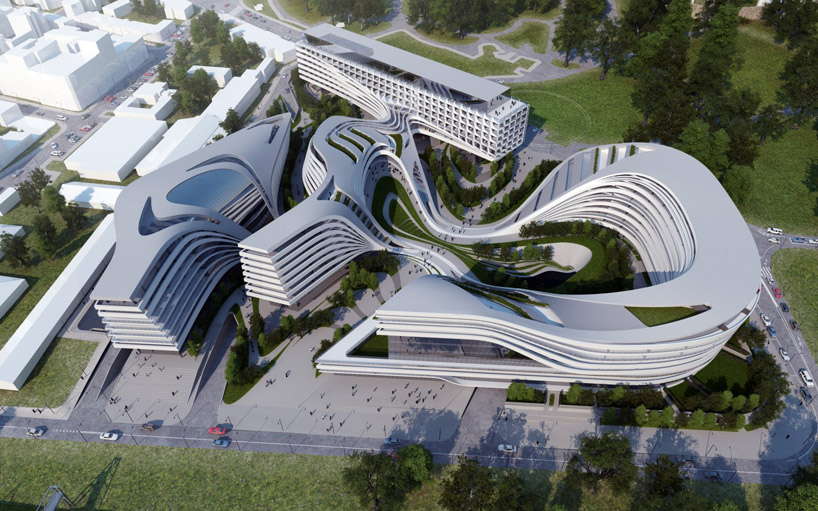
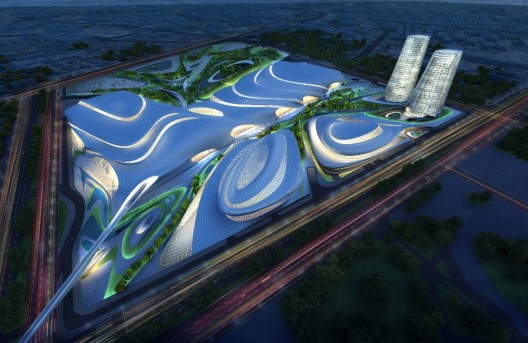
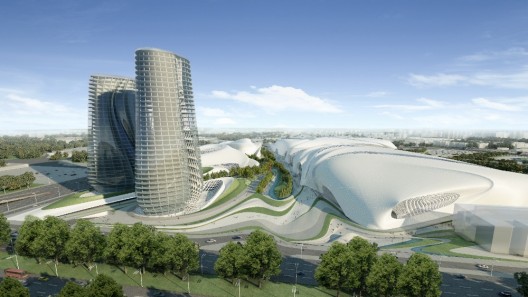
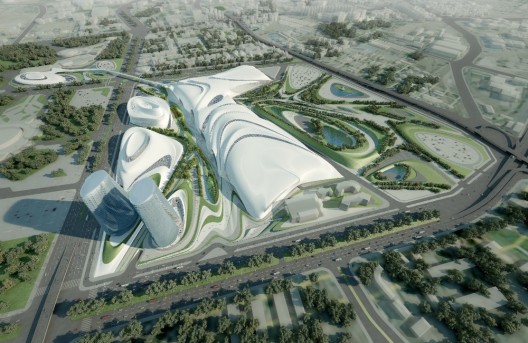
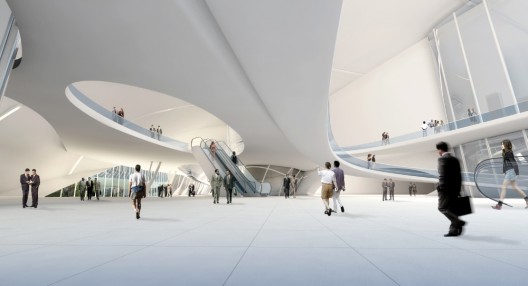
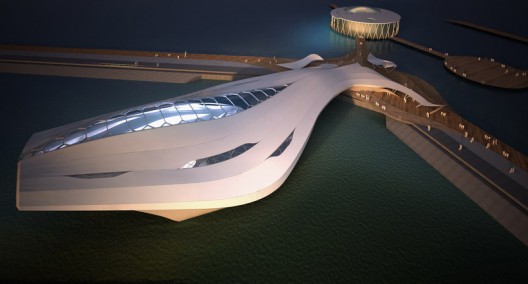
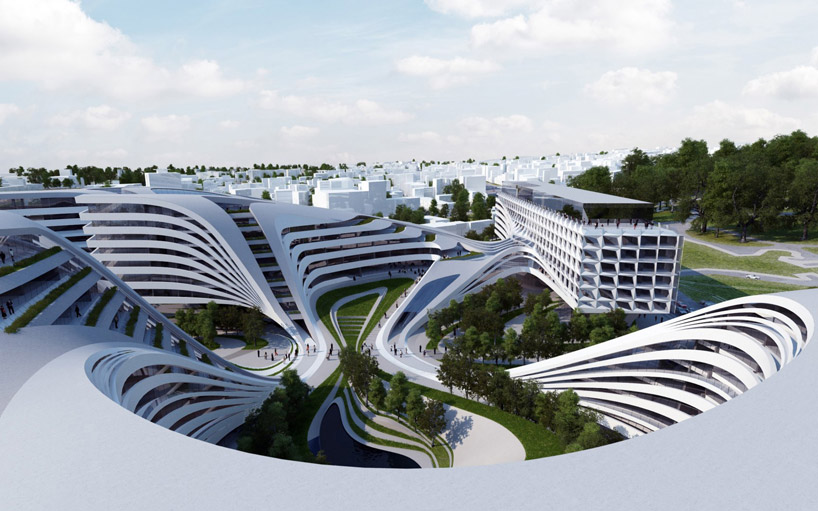
zaha hadid: beko masterplan in belgrade

zaha hadid: beko masterplan in belgrade


ادامه نوشته

Zaha Hadid Wins Japan National Stadium Competition

Zaha Hadid Wins Japan National Stadium Competition

ادامه نوشته

Sunwell Muse Kitasando / Takato Tamagami and Tsutomu Hasegawa

Sunwell Muse Kitasando / Takato Tamagami and Tsutomu Hasegawa

N-House / Takato Tamagami

N-House / Takato Tamagami

ادامه نوشته

El estudio A-cero: Madrid

El estudio A-cero: Madrid


ادامه نوشته

Cafe la Miell by Suppose Design Office

Cafe la Miell by Suppose Design Office


cl_040910_04 cl_040910_05

cl_040910_06 cl_040910_07

 
ادامه نوشته

Esculturas para vivir


ادامه نوشته

Republic Square / Eric Owen Moss Architects

Republic Square / Eric Owen Moss Architects


ادامه نوشته

Taiwan favours international design for TCDC

Taiwan favours international design for TCDC


ادامه نوشته

House of inclusion by FORM/Kouichi Kimura Architects

House of inclusion by FORM/Kouichi Kimura Architects

squ02_fkhs_003_s.jpg

ادامه نوشته

Khyber Ridge / Studio NminusOne

Khyber Ridge / Studio NminusOne

ادامه نوشته

Harvard University: Projects by Alumni and Students

Harvard University: Projects by Alumni and Students

ادامه نوشته

Gigon / Guyer

Gigon / Guyer

Annette Gigon and Mike Guyer, for more than 20 years, make a solid and elegant architecture. They gained notoriety by qualifying the urban landscapes of Switzerland, a country where good architecture can be seen easily. Gigon / Guyer are certainly a great source of inspiration for architects and enthusiasts.

Architect Day: Gigon/Guyer

Photos from gigon-guyer. ch.


ادامه نوشته

In Progress: Z Towers / NRJA

In Progress: Z Towers / NRJA


ادامه نوشته

2012 Yeosu Pavilion proposal by PTA

2012 Yeosu Pavilion proposal by PTA


ادامه نوشته

Little big planet

Little big planet


ادامه نوشته

Beijing Central Business District / Skidmore, Owings & Merrill

Beijing Central Business District / Skidmore, Owings & Merrill


ادامه نوشته

Lavender Lake Competition winners announced

Lavender Lake Competition winners announced


SUBWAY VIEW

ادامه نوشته

Stadiums for the 2014 World Cup in Bra

Stadiums for the 2014 World Cup in Brazil

ادامه نوشته

Diller Scofidio + Renfro win competition for the new Image  

Diller Scofidio + Renfro win competition for the new Image and Audio Museum in Rio de Janeiro

ادامه نوشته

Ferry Terminal / F451 Arquitectura

Ferry Terminal / F451 Arquitectura

portada copy


ادامه نوشته

Urban Resort San Petersburgo / WMA

Urban Resort San Petersburgo / WMA

ادامه نوشته

Automotive Showroom and Leisure Centre by Manuelle Gautrand Architecture

Automotive Showroom and Leisure Centre by Manuelle Gautrand Architecture


ادامه نوشته

Serpentine Gallery Pavilions over the years

Serpentine Gallery Pavilions over the years
serpentine_ito_dezeen.jpg

ادامه نوشته

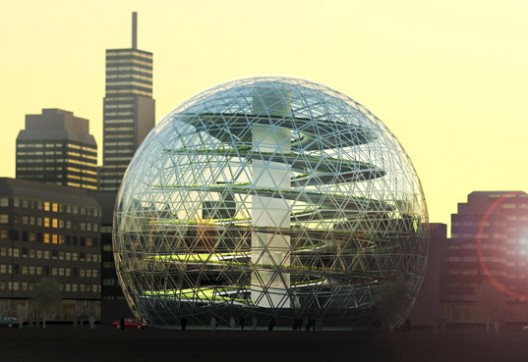
Plantagon’s Vertical Farm

Plantagon’s Vertical Farm

ادامه نوشته

ZAC bords de seine / ECDM Architects

ZAC bords de seine / ECDM Architects


ادامه نوشته

Monolab’s High Rise Tower

Monolab’s High Rise Tower

ادامه نوشته

ThyssenKrupp Elevator Competition / RSVP

ThyssenKrupp Elevator Competition / RSVP


Our friends from RSVP Architects just shared with us their proposal for the ThyssenKrupp Elevator competition in Za’abeel Park, Dubai.  The tower seems to morph out of the water and into the air, creating a structure that acts as a monument during the day, and an icon during the night.
More images and further project description after the break.
The architects explained, “The overall form evolves out of a seashell or oyster shape that keeps turning towards the sky as if the forces of the water and the wind had collaborated in this architectural metamorphosis, where the vertical element removes a pearl from the oyster and places it high above ground as the precious object to be contemplated and occupied, the end of a journey where one is finally able to contemplate a view of the entire city.”
Programmatically, the building is arranged with conference rooms and a children’s library in the lower sections, and the raised restaurant toward the top.  While Dubai is famous for gaining land from the ocean, here the site is flooded to create a park around a lake and an aquarium that is part of the main project circulation.
The 170m twisting tower is supported by a diagonal steel mesh.  Due to its form, the tower is viewed differently depending upon the viewers’ perspective.  During the day, the sky becomes an integral part of the facade, while at night, it is illuminated like an “impressive and dynamic lighthouse” representing Dubai’s momentum and aspirations. The panoramic elevator becomes the key element in the procession upward where the sky is constantly providing the backdrop and the wind can easily flow through the structure.


Mixed Use Tower / Moho Architects

Mixed Use Tower / Moho Architects

Spanish firm Moho Architects are currently in the schematic design phase of a mixed use tower for San Jose, Costa Rica.  The tower, whose programmatic elements will range from commercial and retail spaces to offices and hotels, aims to create a strong model of sustainability for the region that will promote eco-friendliness.
More images and more about the tower after the break.
 
The building’s form is conceived of as independent strips that begin to peel away from each other as the tower rises.  Voids are punched through the form to create viewing platforms and a space to add greenery.   The shifting of these strips allows natural light to flood the interior spaces and nurture the vegetated sky courts.
The façade’s wooden brise-soleil filters solar gain while its layered composition reduces the air-conditioning load.   Since the design allows so much light to pass through the space, the need for artificial lighting is nearly eliminated.  By providing a variety of activities in one building, the reliance on transportation is reduced dramatically since both day and night time activities reside in one area.
It is the hope that after this tower is constructed, its success will promote the notion of incorporating sustainable ideas into all structures in the area.
As seen on designboom.  Images courtesy of the studio.
General Information
Location:  Bulevar Las Américas, Sabana Norte, San José, Costa Rica.
Architecture: Moho architects.
Built surface:   28.000  sqm
Preliminary drawings: December 2008


Erika Mann Elementary School / Die Baupiloten

Erika Mann Elementary School / Die Baupiloten


Architects: Die Baupiloten
Location: Berlin, Germany
Client:
Stattbau Berlin - Stadtentwicklungsge sellschaft mbH
Project Team: Maximilian Assfalg, Ania Busiakiewicz, Andrea Ceaser, Fee Kyriakopoulos, Ansgar Schmitter, Irmtraut Schulze, Thilo Reich, Wojciech Wojakowski
Sponsors: Baustoffhandel Mammitzsch, Eternit, Eurostahl, Follenius und Martin Tischlerei, GLS Bank Bochum, Firma Transresch, Bristol Kempinski Hotelkette, Essensanbieter Luna and Ridi Leuchten
Project year: 2006-2007
Photographs:
Jan Bitter
 
 
The Baupiloten are a group of students at the Institute for Architecture within the Berlin Technical University’s Department for Planning, Construction, and the Environment. Under the leadership of architect Susanne Hofmann AA dipl, the Baupiloten conduct their studies through the realization of actual building measures. The students experience the architectural curriculum as a praxis-oriented ideal and take part in all phases of design and construction.

“The Snuffle of the Silver Dragon”

The Baupiloten create an all-day “home-away-from- home” for grade-schoolers
Following the successful modernization of the Erika-Mann Elementary School in the Utrechter Strasse 25/27 - 13347 Berlin, the Baupiloten have now designed the building’s interior for all-day use. With new seating-landscapes and worlds of recreation, the Baupiloten - together with the schoolchildren - expanded upon the concept of a comfortable learning environment to include the school’s hallways and classrooms. Until recently, the hallways of the school building (designed by Ludwig Hoffmann in 1915) embodied the sterile and authoritarian educational atmosphere of the early 20th century. In their redesign, the hallways were made to suit modern educational concepts of a “rhythmic” learning atmosphere, thereby serving the current need for communal areas of varied use.

program axo

“Form Follows Kids’ Fiction”

Working together with the Baupiloten in a series of workshops, the students created fantastical and poetic worlds, culminating in the fictive “Snuffle of the Silver Dragon”. This was a further development of the “Silver Dragon World” created in the school’s hallways in 2003. The “Snuffle of the Silver Dragon”, a veil covering the floors and ceilings of the schools 3 upper stories, functions (depending on weather conditions) as a brilliant light filter.

Children as Designers of their Worlds

Beyond the collaborative process, children should be able to form their daily environment - not only suggestively in the form of ideas, but as actual co-designers of their world. In the school’s three upper stories, a seating landscape was created in a series of openings contained within the “Snuffle of the Silver Dragon”. In these openings, the children can relax upon soft, warm materials. The landscape is composed of five modules: couches, caverns, lairs, pedestals, and tables with fold-out benches. These modules allow the children to test their bodies and find the most comfortable position in which to learn or play, without having to conform to seating norms. The children can communicate via the “Snuffle Beatle”, a total of 34 reflectors placed around the building.

The “Snuffle Garden” on the schools second story offers a series of horizontal and sloped surfaces on which the children can lay, sit, or slide. Particles such as the “Wings” and “Fireflower” float inside the “Snuffle of the Silver Dragon”. The particles are fold-out chairs and sculptures on which the children sit or retreat into - either together or on their own. Warm rays of light shine into the particles from the ceiling, covering the seats in a golden glow.
The hidden “Dragon’s Treasure” is also located on this story. The children decorate its magnetic walls with colorful mosaics that can be changed however they please. On the 3rd story, the “Snuffle of the Silver Dragon” is entangled within the Kaleidoscope. A gallery of mirrors optically dissolves the geometrical space; the walls and ceilings of the hallway are equipped with highly reflective field of metal panels, penetrated only by a collection of images composed of 270 picture frames. The children decorate the picture collection with their own creations, allowing their images to be endlessly reflected and providing for a constant change in spatial perception.

The “Chill Room”, also located on the third story, is a landscape of seating-pedestals covered with foam, tarp, and various textiles. A series of one-meter high “Petals” form a protective island around the pedestals, large enough for two to three children. These protective islands are made of wooden frames and can be individually formed by the children. Thus, the children are able to form their own environment according to their wishes through the manipulation of sound, light, and laminate.


Site One / Elenberg Fraser

Site One / Elenberg Fraser

© Tony Miller

Architects: Elenberg Fraser Architecture
Location: Melbourne, Victoria, Australia
Project Management: Baracon
Civil Engineering: Reeds Consulting
Structural Engineering: Robert Bird & Partners
Services Engineering: Norman Disney & Young
Building Surveyor: Garden Group
Fire Engineer: Umow Lai & Associates
Acoustic Engineering: Marshall Day
Wind Engineering: Mel Consultants
Environmental Engineering: ERM
Quantity Surveyors: Slattery Australia
Land Surveyor: Reeds Australia
Geotechnical Engineering: Golders Associates
Project year: 2007
Client: Pan Urban
Photographs: Tony Miller
 
© Tony Miller © Tony Miller © Tony Miller © Tony Miller
 
Built on a highly visible corner site in Melbourne’s Docklands, Site One is a six level commercial building mixing commercial office tenancies, flexible and fully serviced business facilities, and sohos (small office home office) that provide work/ live opportunities.

Completing the Base

The building anchors its edges to Bourke St and Stadium Drive, stepping back across the frontage to align at the top with the Watergate Towers. This completes the geometry of the block, and provides a commercial supplement to the residential program of the adjacent Watergate.


ground floor plan

Urban landscape oasis

The main building entry is from Stadium Drive via an open landscaped forecourt, which runs deep into the building via the main lobby. The forecourt is accessed across tenancies on two of its edges and the lobby along its internal face. The courtyard is the focus of the stepping roof form and the terraces. The network of stainless cables that wrap in and over the building, form a rich multi-levelled landscape and recreational space.

Network of movement referencing the historical

Site One is held back from the western boundary of the site to create an arcade space which spans the site. The incorporation of this connection establishes a historically Melbourne sense of the movement network of arcades, laneways and alleys. This also encourages movement across the site from Stadium Drive to Bourke St and the Docklands waterfront beyond. The north-south arcade links into the main lobby to form a network of vertical voids running across the site, collecting the circulation and entries to the commercial suites. In addition this void network forms fresh air ‘ducts’ across the site for ventilation, giving the arcade a sense of both the internal and the external.

© Tony Miller

The Program

Site One comprises 14 retail tenancies to the ground floor, 24 serviced office suites, 29 strata offices and 73 sohos to the upper levels. Facilities within the building at ground level add retail and café functions to the wider precinct, enabling surrounding building occupants to use, enjoy and move through the site on a daily basis and add to the public experience of the site. The Business Club is located within level 1 and comprises integrated business facilities such as secretarial and printing services, meeting and board room facilities and informal and presentation lounges. The sohos are fully wired for high bandwidth cabling, and incorporate wi-fi LAN connections. Up-to-date databased website services are also provided with R&D and technical support for all businesses within Site One.

© Tony Miller

The project brings integrated ESD initiatives to the small commercial tenancy. Glazed arcades and full height voids are utilised as fresh air, supply and exhaust ‘ducts’ to the individual offi ce shells. This also provides natural ventilation to public areas, ensuring temperature comfort levels are maintained in all public and private spaces. The building façade incorporates operable sections of glazing to aid passive ventilation.
Site One presents a fl exible commercial model to the Docklands precinct, referencing a fi ner grain of urban experience that is historically very Melbourne, through an iconic building that is ‘in and of’ its site.

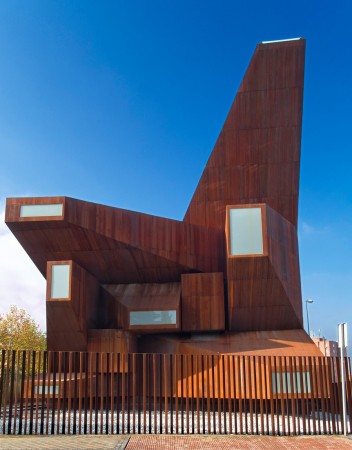
Parish Church of Santa Monica / Vicens & Ramos

Parish Church of Santa Monica / Vicens & Ramos


 Architect: Vicens & Ramos / Ignacio Vicens y Hualde, José Antonio Ramos Abengózar
Location: Rivas-Vaciamadrid, Madrid, Spain
Client: Obispado de Alcalá de Henares
Collaborators: Fernando Gil, Agustín Toledano, Roberto Rodríguez-Paraja, Jesús Gómez, Desirée González, Pablo Gutiérrez, Romina Barbieri, Raúl Rodríguez, Tibor Martín, Patricia de Elena
Photographs: Pablo Vicens y Hualde & Ricardo Santonja


“The project whose is already completed is the third proposal. The first two were rejected and it’s a shame. I think that they were much more interesting, at least from the point of view of adherence to the liturgical rules of Vatican II.”
Vicens & Ramos
Following the guidance of the Diocesan Council of Temples and the program of requirements provided by the same and later adjusted to the needs of the Parish of Santa Monica, the building design integrates in one building all the spaces that correspond to Church, Parish offices and priest housing.

section

The generating idea of the project was that of situating, within the confusion of the surrounding urban environment, a building that would mark a milestone and become a continuos testimony to the spiritual function produced in its interior, and which must necessarily spread and manifest itself permanently to the nearby social and urban medium.
The intention to unify had priority in the conception of the building, that is long and narrow, curved to fit the road along its westerly aspect and cut off abruptly at the north-easterly face. Described by the architect as “an explosion, frozen in an instant after detonation”, the sculptural protuberances at the north end seem to jostle for the light, and almost resemble a hand pointing heavenwards.
 

The complex is made up of two independent buildings: one houses the church, strictly speaking, and the daily chapel, in a structure with large steel porticos, while a second block with a structure of reinforced concrete accomodates the housing and parochial rooms. Both are tied together by a continuous corten stell skin which, as a whole, creates a piece that gives an image of great unity and rotundity.
The northern and southern façades are symmetrical except in the building of parochial spaces, where on the northen face the steel skin curves to form the main access to the nave.

At the foot of the nave is located the High Chore, which can be accessed directly from the nave by a stairwell and has a seating capacity of 77 and a common lightning system with that of the rest of the nave. The most public and daily zones turn towards the Avenida de la Integración, while the bedrooms face the interior street.
More info about Vicens & Ramos over here.


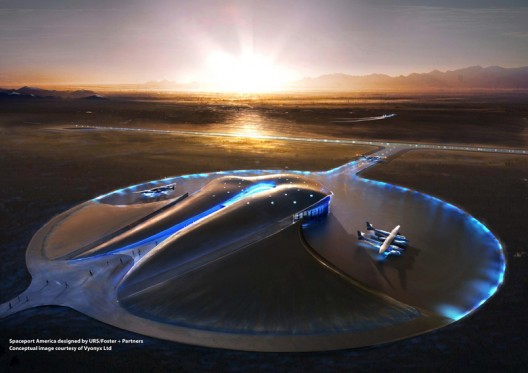
Spaceport America began construction last Friday

Spaceport America began construction last Friday

Spaceport America, the first spaceport ever began construction last Friday in New Mexico. The spaceport, designed by Foster + Partners and URS Corporation will host commercial operations by private space travel companies, like Virgin Galactic.
The 110,000-plus square foot facility will use cost-effective, energy-efficient green building practices and will be built to be LEED-certified. From earth-tubes that will pre-condition the air to reduce HVAC costs by 50-70% to solar thermal panels on the roof for hot water to the embedded in-floor loop system, Spaceport America is both unique and iconic in terms of visual and environmental design.

Seen at Gizmodo. More images after the break.


هتلهای عجیب

هتل شناور در سوئد

در این هتل همه امور اجتماعی در جریان هست و مهمانان میتوانند از هوای خوب و دریای بی کران لذت ببرند و شبها در کنار صدای امواج به خواب بروند

Floating Hotel in Sweden

هتل شن و ماسه در بریتانیا

اولین هتل ماسه ای جهان به شکل یک قلعه در ساحل Weymouth در شهر ساحلی Dorset در بریتانیا است.

Sand Hotel in United Kingdom

هتل جنگل در مکزیک

V-Houses, an amazing jungle retreat near the fishing village of Yelapa in tropical Mexico. این دیگه خیلی جالبه . وسط جنگل با حال و هوای بکر طبیعت تازه اونم با همچین معماری عالی و عجیبی . درست شبیه اهرام وارونه هستند اما خودشون بهش میگن موشک هتل .

این هتل در یک جنگل گرمسیر در نزدیکیهای دهکده ماهیگیری Yelapa در کشور مکزیک قرار دارد.

Jungle Hotel in Mexico

Jungle Hotel

هتل یخ در کانادا

یخ هتل منحصر به فرده و هرجور حساب کنید یک تجربه منحصر به فرد و غیر قابل قیاس هست و یه جور خود آزاری هم محسوب میشه .

Ice Hotel in Canada

هتل کپسول در ژاپن

به اینها میگن هتل کپسول . احتمالا باید خیلی هم ارزون باشه . اما من که یاد قفسه های سردخونه افتادم.

Capsule Hotel in Japan

هتل جعبه بقاء در هلند

هتل امدادی ، که استفاده ای دیگه از جعبه بقای هست ، در یک کانال در آمستردام هلند واقع شده است. ازین جعبه ها در پای دکل ها و سکوهای دریایی استفاده می کنند.

Survival Pod Hotel in Netherlands

غار و هتل در ترکیه

یک هتل غیر عادی با فضایی افسانه وار و یک محیط کاملا عجیب و غریب. یه جورایی مثل کندوان خودمونه . فقط اونا میدونن باید چجوری جاذبه هاشون رو معرفی کنن و ما هم فقط تماشا می کنیم.

Cave Hotel in Turkey

هتل هواپیما در سوئد

هم اکنون شما می توانید شب را در یک جت واقعی اقامت داشته باشید.

Airplane Hotel in Sweden


هتل خونه جنگلی در هند

به این میگن یک صمصمیت حقیقی با طبیعت. حیات وحش و آماده برای دریافت تجارب فوق العاده و شگفت انگیز واقع در قلب طبیعت و حقیقت.

Treehouse Hotel in India

هتل زیر آب در فیجی

یک مسکن لوکس در عجیب ترین شرایط ممکن.زیر دریا .. باید خیلی جالب باشه.

Underwater Hotel in Fiji


لوله زه کشی هتل در اتریش

این یکی دیگه باور نکردنیه . این اتریشی ها معماری و سبک کارهاشون همیشه عجیب و غریب بوده.

Drain Pipe Hotel in Austria

ORDOS 100 #41: Single Speed Design

ORDOS 100 #41: Single Speed Design

This villa is located in plot #92 of the ORDOS project.
Architects: Single Speed Design
Location: Ordos, Inner Mongolia, China
Principals in Charge: Jinhee Park AIA, John Hong AIA/LEED
LProject team: Brett Albert, Frederick Peter Ortner, Matt Allen, Caroline Lang, Clara Wong, Bao Wei
Structural Engineer: Paul Kassabian, SGH Inc.
Design year: 2008
Construction year: 2009
-2010
Curator:
Ai Weiwei, Beijing, China
Client: Jiang Yuan Water Engineering Ltd, Inner Mongolia, China

Constructed Area: 1,000 sqm aprox

Early on we noticed that that the overall project siteplan is a cleverly devised urban scale display system for a hundred different architectural experiments. Instead of deploying traditional property lines where no audience can tread, pedestrian easements relentlessly surround every lot. Within the abstraction of the desert, each team is liberated: without formal guilt we are given license to create autonomous product-like villas that can be viewed on all sides by an equally abstract audience.

From this cue, we took the opportunity to create a solution that on one hand references the local environment but also offers a more prototypical attitude toward energy savings - a solution that might be adapted to other building types beyond housing. Eight towers are proposed, each containing a separate and distinct program: an entry tower, a living tower, a food tower, a gym tower, 2 bedroom towers, and 2 bathroom towers. Through the distortion of each tower’s geometry, strategic connections and segregations are created. Organizing the program in this way permits greater efficiency, as only one-third of the towers are occupied and require the consumption of energy at any given time during a diurnal cycle. The organizational system also heightens the experiential differences between rooms that are necessarily similar in size, while creating a high level of porosity between interior and exterior spaces.


Duplex House for Make It Right / GRAFT

Duplex House for Make It Right / GRAFT

ne_street

GRAFT was one of the first practices that started working with Make It Right to redevelop the Lower 9th Ward area in New Orleans. Their single family home design has been picked by 3 homeowners so far, with 2 already finished and 1 in construction phase.
GRAFT’s proposal for the new set of duplex homes we featured yesterday, has LEED Platinum certification and in my opinion proposes an interesting strategy to connect with the street level, mandatory to all MIR projects.
Architect’s description and more images after the break:
After the success of the first round of designs for the Lower Ninth Ward a new group of architects was invited to design dwellings. GRAFT donated another design, this time with a larger building for up to two families. The Round 2 house deploys a similar formal strategy of blending as does GRAFT’s Round 1 shotgun house. A strong visual connection to the Round 1 house was maintained in order to bring consistency of character to the New Orleans’ Lower Ninth Ward, which will continue to be populated by these types of dwellings. Here, we have additionally drawn inspiration from the camelback shotgun typology. Historically, camelbacks emerged as a way for residents to add a partial second story to a residence, whether simply to gain more space for a single-family home or to add a rental unit at the rear of a structure. In our design, we utilize the camelback strategy to stack a second efficiency unit above a first floor shotgun house.

nw_backyard

A critical programmatic goal within the design is to establish a strong connection between the private interior zone of the house and the shared public space of the street. The primary challenge in achieving this goal lies in negotiating the 8’-0” first floor height that is required to make the houses safer from future flooding of the street level. The broad and spacious deck located in the front yard mediates the relationship between public and private by raising the deck 5’-0” above grade. This offers a welcoming gesture to the street while at the same time creating a semi-private space for the inhabitants of the house to enjoy.

section

section

Residents may enter the house from the side porch landing, leading them into a large open space, containing living, dining and kitchen functions. The lower unit has a flexible three bedroom layout that can be converted into a two bedroom and office layout if desired. The master suite at the rear of the house contains an en-suite bathroom that shares a common wet wall with the unit’s other bathroom and kitchen making a cost-efficient plumbing core.

ne_above

An exterior stair carries the inhabitants of the efficiency unit up to a rooftop terrace entry deck. This secondary deck level may be utilized as a private deck for the upper dwelling. It provides a generous outdoor living space, views of the neighborhood, space for a small vegetable or herb garden, and easy access to the solar panel array for maintenance. The upper unit itself is designed to be a simple one bedroom dwelling with a living room and dining area facing the backyard. Here the efficiency kitchen shares a wall with the bath to form a cost-efficient plumbing core. The kitchen forms an ‘L’ at the perimeter of the living and dining area in order to create an open and inviting space.


Xixi Wetland Art Museum / Studio Pei-Zhu

Xixi Wetland Art Museum / Studio Pei-Zhu

by Studio Pei-Zhu

Chinese Studio Pei-Zhu has designed the Xixi Wetland Art Museum located in a rural nature preserved near Hangzhou, China. The concept stems from the interaction between building and nature. As leaves fall from trees they arrive naturally on the ground. The resulting form creates shelter against the earth.
This design creates the genuine qualities of scattered, fallen leaves and shelter through five buildings. Some leaves overlap and attach with other leaves. One leaf remains separate, yet still unites in visual language with the linked leaves. The four linked structures house functions for business, recreation, a hotel, restaurant, and reception. The single standing leaf is the art museum.
The buildings are covered by light colored, reflective zinc panels that have a brushed finish, resulting in a diffused and soft reflection of their interactions with people and nature. this blending influences a person as they experience the museum. All colors, light, and details merge into a continuous representation that is not recognizable as individual objects, but are distinguished as a uniform and natural image.

Seen at designboom. More images after the break.


Polish Pavilion / WWA Architects

 Polish Pavilion / WWA Architects

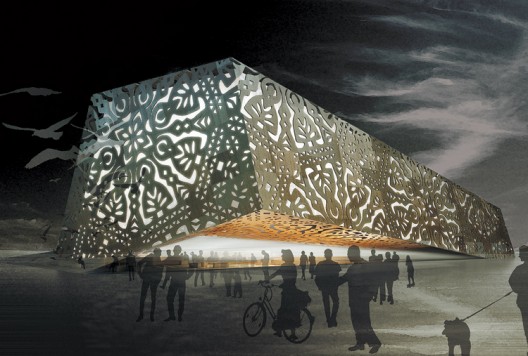
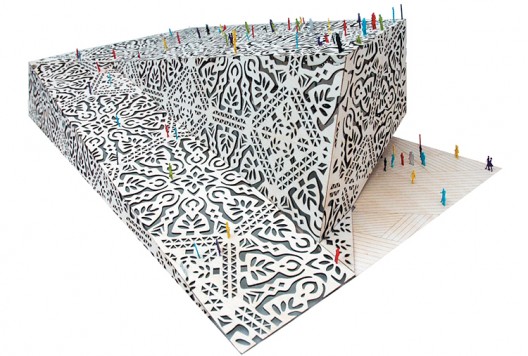
WWA Architects have created a conceptual design for Polish Expo 2010.  With the exhibition housing pavilions from countries all over the world, each pavilion must provide a strong aesthetic message to attract visitors and then provide insight to the country. WWA’s pavilion creates a distinct stylistic motif taken from the folk-art paper cut-out to create a “memorable cultural ideogram”.   The intention was for “the structure décor to draw on and make reference to tradition, but ultimately to be that tradition’s contemporary reinterpretation, a creative extension into the present day by way of inspiration rather than replication,” explained the architects.
More images and more about the pavilion after the break.

Striving to make the design more than a literal interpretation of the folklore patterning, the architects seek to use the design in “a purely architectural dimension”  to create an attractive space aesthetically as well as functionally. The slanting planes of the structure create “a geometrically intriguing and flexible space that can be creatively apportioned, by inner divisions, to different exhibition, performance and utility functions and uses.”

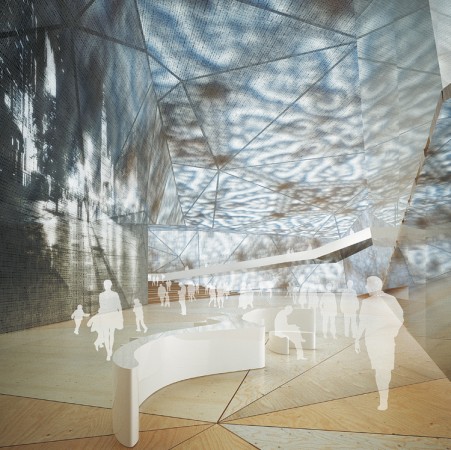
The pavilion creates a route for the visitors to follow, which outlines a logical progression through the space.  The path first circulates around the information center before leading to the full-height exhibition space.  This main area, with light filtering through the cut-out patterns of the elevation, consists of solid walls that function as screens.  The screens project images of Polish city life and provide the backdrop for cultural performances in an effort to place the viewer in the appropriate setting.
The route continues to flow through the pavilion, leading up a terraced viewing platform and eventually to the roof level, known as the “viewing spot.”  The slanted roof provides an area for outdoor performances as well as prime seating for viewing the whole exhibition.

Wood is the main construction and finishing element while the outer layer of the elevation is made of impregnated laser-cut plywood mounted on glued wood construction modules with flitch plates. Panel wall elements made of glass, polycarbonate, hydro or UV resistant materials are mounted on the outer side of the modules. On the inner side, semi-transparent PCV or Tyvek type material membranes will be additionally mounted, on which the patterns of the outer elevation will be projected.


Vaeksthuset Botanical Garden / Cebra

Vaeksthuset Botanical Garden / Cebra

Cebra, a Danish architecture firm, will design a botanical garden for Aarhus University, Denmark’s second oldest and second largest university (after the University of Copenhagen).  The botanical garden and greenhouse design will bring greenery to the campus by providing 29,600 sq feet of an expansive area of flora and fauna.. The project was designed for a building competition that required the restoration of existing buildings and the creation of one new building.
More about the design after the break.

Entitled the “Vaeksthuset,” the botanical garden creates an attractive space for students meandering around the campus. The interior features round pods that are inspired by natural forms.  A facilities complex branches off the gardens to provide office space and cafés.

The third component of the project, an outdoor garden, will be partially covered and connects to the greenhouse under a long glass corridor.  In the greenhouse, the largest dome is covered with a glass roof, allowing natural light to nurture the plants.
With this design, Cebra aims to make nature an integral part of the campus and create a new atmosphere for the students to experience on a daily basis.
As seen on designboom.

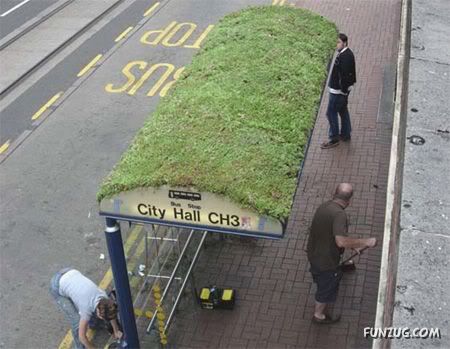
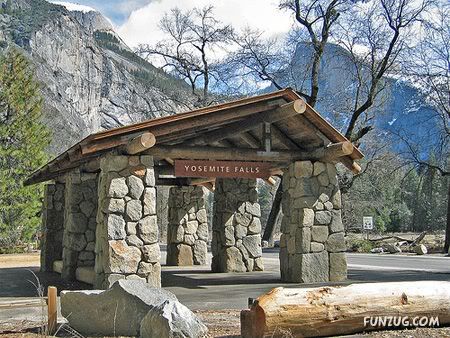
This increible bus stop was designed by Dennis Oppenheim in Ventura California

This increible bus stop was designed by Dennis Oppenheim in Ventura California

Cool Bus Stops around the World


This bus stop allows skaters to go on a mini ramp attached to a bus stop,

Cool Bus Stops around the World


It's a Quiksilver ad Swing on a Bus Stop in London, part of Bruno Taylor's "Playful Spaces"

Cool Bus Stops around the World


Art project

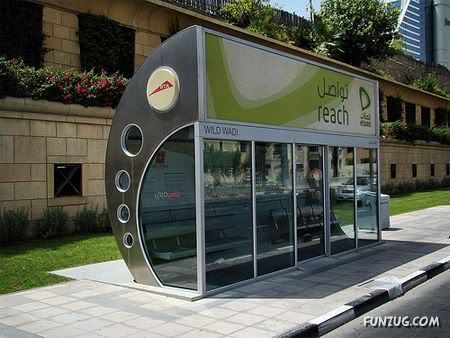
Air-conditioned bus stop, presumably near Burj Al Arab hotel in Dubai

Cool Bus Stops around the World


The Simpsons Bus stop in Germany, The caption says "Use Only In Case of Sith"

Cool Bus Stops around the World


Advertising for the movie This
Star Wars "faux light saber" bus stop ad lights up at night.

Cool
 Bus Stops around the World


Soviet era bus stop

Cool Bus Stops around the World


This living room bus stop was created by Ikea as marketing for the Design Week 2006

Cool Bus Stops around the World


Australia Post Bus Stop Advertisement

Cool Bus Stops around the World


3M was so sure their Security Glass was unbreakable,

they put a large stack of cash behind it and shoved it in a bus stop.

Cool Bus Stops around the World


Cool Bus Stops around the
 World


Cool Bus Stops around the World


Cool Bus Stops around the World


Cool Bus Stops around the World


Cool Bus Stops around the World


Cool Bus Stops around the World


Cool Bus Stops around the World


Cool Bus Stops around the World


Cool Bus Stops around the World


Cool Bus Stops around the World


Cool Bus Stops around the World


Cool Bus Stops around the World


Cool Bus Stops around the World


Cool Bus Stops around the World


Cool Bus Stops around the World


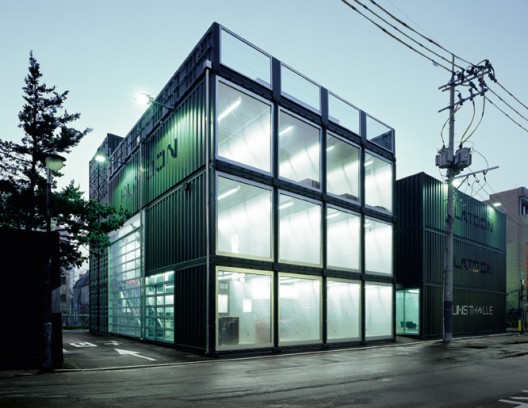
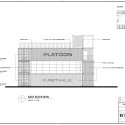
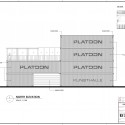
Platoon Kunsthalle / Graft Architects

Platoon Kunsthalle / Graft Architects

Architects: Platoon Cultural Development + Graft Architects
Location: Seoul, Korea
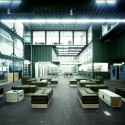
Program: Exhibitions, Bar & Restaurant, Event Hall, Artist Studios, Library Lounge, Office Studios, Workshop Room, Roof Top Bar
Structure: M. Cabestany
Footprint Area: 415 sqm
Main hall Area: 272 sqm
Project year: 2008-2009
Photographs: Platoon
 
construction process
 
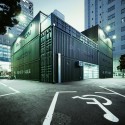
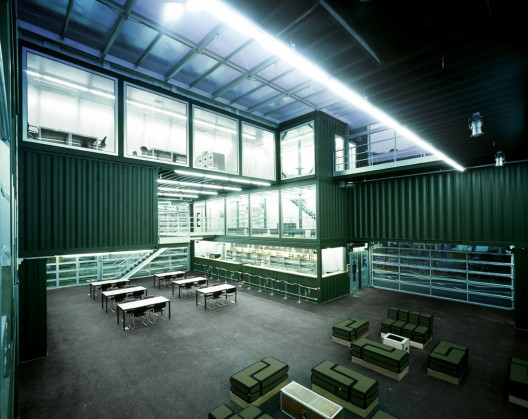
PLATOON KUNSTHALLE opened its doors on 11th april 2009. PLATOON KUNSTHALLE is set up in seoul as a space for subculture in Asia. its programmatic orientation towards cultural movements beneath the radar creates a dynamic space where new ideas are born and presented.
The platoon Europe headquarters in berlin was established in 2000. it runs diverse culture and communication projects in cooperation with an international community of 3,500 creatives from all different professions.

first floor plan

PLATOON KUNSTHALLE is not about entertainment. The program will provide a communication platform for anybody interested in subcultural creative fields like street art, graphic design, fashion, video art, programming, music, club culture, political activism etc.
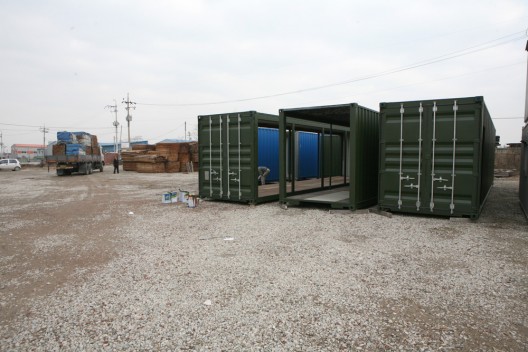
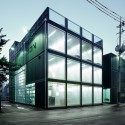
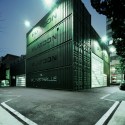
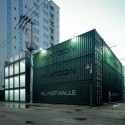
PLATOON KUNSTHALLE is built of 28 iso cargo containers. As icons of a flexible architecture in a globalized culture, the stacked containers form a unique construction that can be rebuilt anywhere else any time.

construction process

As PLATOON KUNSTHALLE is located in the upscale cheongdam area the confrontation of subculture with the close-by design houses, commercial galleries and luxury brand stores creates a tension and interaction between the two worlds.
PLATOON KUNSTHALLE provides showcases of underground artists, studio residencies and a fine selection of cutting-edge stage performances to introduce the energetic potential of subculture in Korea and Asia.

Subculture at PLATOON KUNSTHALLE is presented in different formats like exhibitions, movie nights, concerts and multimedia performances, workshops, discussion panels and special events. the four scholarship programs give young upcoming artists from Korea and abroad the opportunity to develop creative projects at the PLATOON KUNSTHALLE. the four showcases present every month striking works from the subculture and streetart field including leading artists of the international urban art scene.

                                     construction process      construction process      construction process


Benetton Competition / Scheurwater + Hoven

Benetton Competition / Scheurwater + Hoven

In addition to the Benetton competition providing participants with the possibility to redefine the influence of retail in an urban landscape, the competition also provided participants with the choice to design “Building A” or “Building B”.  While we shared some of the winning proposals for Building A (Grzegorz Witold Woronowicz and Giuseppe Iodice), we now share Maarten Scheurwater and Oliver van den Hoven’s proposal for Building B, which placed second in the competition.
More about the winning proposal after the break.
The competition is interesting because although the two buildings are independent, with their locations about 800 meters apart, their programmatic requirements and square footage are identical.  As with Building A, the competition clearly expressed the need for the 12 level building to be formatted in this manner: the underground levels must provide parking and storage space; the ground and first floor (1200 m² each) must be subdivided into 3 commercial units, the second to fourth floor (900 m² each) are designate for office space; the fifth and sixth floors (675 m² each) are for office facilities; and the seventh floor (675 m²) will be apartments.

“The Benetton competition brings together two seemingly conflicting domains: the dynamic world of fashion on the one hand and the static domain of architecture on the other. The central objective of this project is to design a timeless building for an industry that creates new collections and appearances every season,” explained Scheurwater.
For Scheurwater’s proposal, a projected volume roughly covering the entire site is split into two parts: a cube and a thin slab.  The void adds an intimate shopping experience for those passing by to become attracted to the entrance area marked by the two split forms.   This small space creates a welcoming environment to combat the massive form.  ”The programme in the competition brief implies a thinning from the base upwards. This thinning is purposely internalized in this project by means of a large void that gets larger towards the higher levels,” explained the architect.  By keeping the thinning effect internal, the structure maintains it massive silhouette throughout the levels.

Most of the facade features a curtain wall design with 4mm thin slabs of local Persian marble mounted on the outer glass panel of the curtain wall.   The facade creates a translucent feel as light and shadows glow through the marble to highlight the openness and lightness of the interior.  The facade does not only create an interesting environment at the street level, but also carries those same properties through its higher levels.  The filtered light “renders the beautiful textures in the marble and brings calm and character…to this inner world”.  As the light intensity changes throughout the day, so to does the appearance of the facade.  During the night time, the light from the office spaces, shops and apartments filters through the facade in different directions to light the structure “like a lantern that can be distinguished from as far as the elevated highway and further to the South.”

Scheurwater van den Hoven Architecten
Maarten Scheurwater
Olivier van den Hoven

Cloud Tower by the next ENTERprise - architects

Cloud Tower by the next ENTERprise - architects

cloud-tower-by-the-next-enterprise-architects-17.jpg

Cloud Tower is a pavilion for open-air concerts in the grounds of a castle near Vienna, Austria, designed by the next ENTERprise - architects.

cloud-tower-by-the-next-enterprise-architects-16.jpg

Located at Grafenegg Castle along with the copper-clad concert hall in our previous story, the auditorium occupies an existing depression in the landscape, accentuated by further excavations.

cloud-tower-by-the-next-enterprise-architects-18.jpg

Visitors enter the auditorium through a corridor cut into the small hill created with the displaced earth

cloud-tower-by-the-next-enterprise-architects-8.jpg

The auditorium has 1,670 seats with a further 300 on the lawn, while the stage can accommodate an orchestra withup to 200 performers.

cloud-tower-by-the-next-enterprise-architects-1.jpg

The 23 metre tall, steel stage-roof is made of steel and glass, reflecting the surrounding sky and trees.

cloud-tower-by-the-next-enterprise-architects-2.jpg

Photographs are by Lukas Schaller.

cloud-tower-by-the-next-enterprise-architects-14.jpg

Here’s some more information from the architects:
Project title: Wolkenturm – Freiluftbühne & Schlosspark Grafenegg / Cloud Tower – Open-air pavilion Grafenegg
the next ENTERprise - architects
Land in Sicht – landscaping
The castle grounds of Grafenegg are almost 250 years old. Every period has left its traces, and this stylistic variety is one of the reasons for the park’s appeal. The area, with the castle and moat at its centre, has a size of approx. 31 ha. The park and its dendrological collection are open year round and are accessible from two main entrances on the west and east side.

cloud-tower-by-the-next-enterprise-architects-4.jpg

The open-air pavilion in the park is used as a stage during festival season in summer, and as a attraction for excursionists and flaneurs – similar to the gazebos in historical landscape gardens, which were designed as a destination or a stop-over on extended walks.

cloud-tower-by-the-next-enterprise-architects-5.jpg

The pavilion is part of a relational field, recontextualizing the existing elements of the ensemble: the ‘new’ entrance, the riding school, the castle, the ‘Black Gate’ and the ‘Große Senke’ (lit. transl.: large depression). With great ease the pavilion inserts itself into the landscape and, through its topographical configuration, reinterprets formal elements of the landscape garden – the play with perspective and visual relations, with contraction and expansion, with enclosure and opening.

cloud-tower-by-the-next-enterprise-architects-6.jpg

The “Schneise” (loosely translated: an incision in the landscape) creates a vista linking the riding school to the Black Gate, and serves as an entrance to and a passage through the auditorium area. The staging of views and spatial sequences, the framing and hiding of points of attraction, often achieved by the meandering layout of paths in the traditional landscape garden, is a theme taken up by varying the elevation of the incision to achieve this effects. Coming from the castle, the visitor is enticed to proceed by the silhouette of the “cloud tower”, visible behind the artificial mound. Immersing himself into the incision, he tunnels through the hill and – after passing this deep narrow – enters the wide arena of the auditorium and the stage, the ‘cloud tower’ of the stage roof suspended above it.

cloud-tower-by-the-next-enterprise-architects-7.jpg

The basic rule of acoustics for open-air stages, ‘what you see is what you hear’ serves as a cue to explore affinities between perspective and acoustic space. The topography of the existing depression – the “Große Senke” – is amplified by modeling the terrain. Artificial hillocks are created by further excavating the depression and subsequently redistributing the soil at its perimeter. Clearly distinguished from the natural terrain by their geometry, stage and auditorium nonetheless merge fluidly with the topography of the site.
cloud-tower-by-the-next-enterprise-architects-15.gif
The stage roof is designed as an autonomous, sculptured object. Suspended above the landscape on a level with the tree canopies it is placed among the groups of trees as if it were one more of them. The shiny metal surface on the outside reflects the sky and the trees, turning into a cloud-tower.

cloud-tower-by-the-next-enterprise-architects-10.gif

landscaping: Land in Sicht, Dipl. Ing. Thomas Proksch
structural engineering: Bergmeister und Partner, Dipl. Ing. Josef Taferner
acoustics: Müller-BBM, Dipl.-Ing. (FH) M. Wahl
cloud-tower-by-the-next-enterprise-architects-11.gif
basic data
address: Grafenegg 10, A-3485 Grafenegg
country: Austria
client: Grafenegg Kultur Betriebsges. m.b.H., St. Pölten, A
architect: the next ENTERprise – e.j.fuchs | mth.harnoncourt
type: music pavilion
additional information
resident orchestra: Tonkünstler-Orcheste r Niederösterreich
artistic director Grafenegg International Music Festival: Rudolf Buchbinder

cloud-tower-by-the-next-enterprise-architects-12.gif

calendar
competition: Feburary 2005
planning phase since: August 2005
under construction since: July 2006
completed in: June 2007
team
Paul Vabitsch, Egon Niedertscheider, Hannes Oswald, Maja Ozvaldic, Marianna Milioni, Daniel Harrer, Waltraud Hoheneder, Claudia Cavallar
overall planning: ARGE the next ENTERprise | Land in Sicht
architect: the next ENTERprise – e.j.fuchs | mth.harnoncourt
landscaping: Land in Sicht, Thomas Proksch, Wien / Vienna
structural engineering: Ingenieurteam GmbH Bergmeister, Josef Taferner, Jochen Ehmann, Vahrn / Varna, I
acoustics: Müller-BBM GmbH, Prof. Karlheinz Müller, München / Munich, D
light design: Ploderer & Partner, Christian Ploderer, Wien / Vienna
light planning: Wiltschko Lichtplanung, Berndorf, A
calculation: sglw architekten, Werner Silbermayr, Wien / Vienna
reinforced concrete materials consulting
Ingenieurbüro Prof. Schießl, Christian Sodeikat, München / Munich, D.

cloud-tower-by-the-next-enterprise-architects-9.gif

project management: NÖ Hypo Bauplanungs- und Bauträgergesellschaf t m.b.H.., Johannes Reiterlehner, St. Pölten
controlling: Azberger-Höss ZT GmbH, St. Pölten
Fachplaner
construction supervision: BM Horst Pratter, Judendorf-Straßengel
supervision landscaping: Land in Sicht, Andreas Beneš
building physics: Wolfgang Hebenstreit, Wien / Vienna
geological survey: Mario J. Pototschnik, Wien / Vienna
site survey: Gerhard Senftner, St. Pölten
HKLSE-Planung: Christian Koppensteiner, Wien / Vienna
contractors
general contractor: Alpine Mayreder Bau GmbH, Zweigniederlassung NÖ, Horn
steel construction: Pagitz Metalltechnik GmbH, Wien / Vienna
prefabricated concrete: Alfred Trepka GmbH, Ober-Grafendorf
drywall: Perchtold Trockenbau GesmbH, Wiener Neudorf
Schlosserarbeiten: Heinrich Renner Ges.m.b.H., Langenlois
carpenter: Pöchlhacker Holzbau GmbH, Ybbs
glazing: Rigo-Glas GmbH, Wien / Vienna
paint: Farben Traht, Etsdorf am Kamp
electrical installation & equipment: Eichinger&Stuber, Langenlois
plumbing equipment & installation: Caliqua Gebäudetechnik GmbH, Wiener Neudorf
garden & landscape gardening: Kanovsky Gmbh, Klagenfurt

cloud-tower-by-the-next-enterprise-architects-13.gif

technical data
seats: 1.670 auditorium seats, 300 lawn seats
height of stage roof: 23 m
stage width: approx. 20 m
stage depth: approx. 11 m
maximum orchestra stength: approx. 200 artists
net floor area: 651 m²
 stage: 228 m² 
backstage area: 203 m²
 artists’ washrooms: 27 m² 
 acoustic buffer: 16 m²
 artists’ wardrobes: 35 m²  piano storage: 11 m²
 HVAC room: 15 m² audience washrooms: 115 m²
Park area: 31,5 ha
construction
Stage structure: concrete; stage roof: steel/glass; auditorium: prefabricated concrete; stage backdrop: double-layered lightweight structure.

Chaoyangmen SOHO / Zaha Hadid Architects

Chaoyangmen SOHO / Zaha Hadid Architects

 
soho_zaha
 
Bert from Moving Cities (a blog  focused on contemporary architecture in China)  just told us about a new project by Zaha Hadid in Beijing: Chaoyangmen Soho.
The announcement was made by Pan Shiyi, a real estate mogul  chairman of SOHO China. Pan has been working on huge developments, such as the Commune by the Great Wall and several commercial projects in central Beijing.
What’s interesting on SOHO’s developments, is that they invite renowned architects to participate, under heavy budgets restrictions in order to delivery quality projects for the “stylish middle class”.  They also have a great corporative culture as you can see on their website.
But back to this project, Bert points us out to a recent interview with Pan Shiyi:
Q: Which development project is your favourite?
A: Chaoyangmen SOHO. It is our latest development. I asked British architect Zaha Hadid to design a creative project, and she did. The project is unique, like the Beijing bird´s nest [Beijing National Stadium].
Read more about this project at Pan Shiyi’s blog. More images after the break.
 
soho_zaha2
soho_zaha3


Zhuhai Opera House / SPF architects

Zhuhai Opera House / SPF architects


SPF Architects, based in Culver City, California, have created an design for the Zhuhai Opera House in Guangdong Province, China.  Learning from the traditional principles of the region,  the opera house’s form gives the appearance of stacked pebbles.  Such an idea was conceived as a way to create a visual balance based on the Chinese principle from the five element theory.   The opera house has three stacked levels that provide varying programmatic activities, such as a 1500 seat auditorium, large plaza gathering space, rehearsal hall, restaurants and other public amenities.  A forest behind the structure gives the impression of growth and sustainability. 
More images after the break. 
Images courtesy of SPF architects.  As seen on designboom.


Business Center Miramare / 3LHD

Business Center Miramare / 3LHD

Architects: 3LHD
Location: Zagreb, Croatia
Project team: Sasa Begovic, Marko Dabrovic, Tatjana Grozdanic Begovic, Silvije Novak, Tin Kavuric, Josko Kotula, Krunoslav Szörsen
Collaborators: Freya (3D), Tehnicke konstrukcije doo, Nikola Miletic, Gadaf Zulbeari
Project year: 2009
Site area: 4,037 sqm
Gross floor area: 37,040 sqm (23,940 + 13,100 underground)
Footprint: 2,084 sqm
Images: 3LHD
 

The competition program is placed on a crossing of two streets, Miramarska and Bednjanska. It is a point of colliding two urban city concepts: north part with classical city blocks of the Zagreb’s lower city enclosed by the railway and the south part primarily along the Vukovarska Street, outlined with modernistic dominant character of mostly public and social buildings.


Concept of awarded project stems from forming a unified structure that will reconcile the surrounding urban matrix and meet the program requirements. Two interacting volumes, a tower with 20 floors and a lower building with 5 floors, unite the planned goals and achieve high quality relations with the neighbouring buildings.. A semi-open atrium between the two buildings connects them with the surrounding public pedestrian surfaces. The underground floors are reserved for garage spaces, ground floor for shops, bars and restaurants. There are 20,000 square meters of office space, and a unique viewpoint at the top of the tower. Simple but at the same time attractive effect of the facade design, made by pulling glass modules in and out, gives the building recognition and uniqueness.


Danish Pavilion for Shanghai / 3XN Architects

Danish Pavilion for Shanghai / 3XN Architects

3XN architects’ proposal for the Danish pavilion for the Shanghai expo 2010 uses their national flag to create a dynamic spatial environment.  ”An exhibition window is an invitation that says: Welcome inside a little piece of Denmark. And in 2010, in the age of globalisation, it is important to add: Welcome to a Denmark that is part of the world,” stated the architects.
The competition for the pavilion was awarded to BIG as we reported earlier.
More about the pavilion after the break.

Even from a distance, the 3,000 sqm pavilion, constructed with red and white rectangles, is easily identifiable with the Danes.   Upon approaching, the building is understood as not only being clad in the country’s colors, but also being a three dimensional version of the flag.  The four red rectangular fields form eight blocks and the white creates an open space in the center where users can view exhibitions.  Entrances and exits are emphasized by the slight shifting of the geometric planes that also provide shelter from the rain and shade on sunny days.

Conceptual thinking for the pavilion led the architects to focus on the four areas used to globally market the country: Denmark as responsible and balanced, with a focus on high quality, experimental and courageous, and characterised by environmental awareness, simplicity and efficiency.  Each characteristic receives its own rectangle so that the characteristics are reflected not only in the individual forms, but also in the pavilion itself.
Images courtesy of 3XN.  As seen on designboom.


Darcons Headquarters by Arquitectura en Proceso

Darcons Headquarters by Arquitectura en Proceso

darcons-headquarters-by-arquitectura-en-proceso-top.jpg
 
Young Mexican architects Arquitectura en Proceso have completed the headquarters of developers Darcons in the suburbs of Delicias City in the Chihuahua state of Mexico.
 
darconshead18.jpg
 
The building consists of three stacked, orthogonal volumes with glazed opposite sides.
 
darconshead10.jpg
 
The western facade is shaded by opaque, concrete walls.
 
darconshead4.jpg
 
Photographs are by Francisco Lubbert and Jorge Cajiga.
 
darconshead1.jpg
 
Here are some further details from the architects:
The site is located at a suburban lot of a middle size city in northern Mexico. As one drives towards it and away from the city, the building appears aligned with the road as an arched gate of a medieval town: looking through it one gets the scenery of the rural fields that surround the city.
 
darconshead2.jpg
 
The building was conceived as a frame that captures part of the landscape and at the same time defines a plane that divides the intercity from the suburbs. The skin of the building plays a dual role: on one hand it is the transparent material that allows the view through it, and on the other hand, it is the opaque continuous skin that defines the shape of the frame and protects the interior from solar irradiance.
 
darconshead17.jpg
 
This skin was manipulated in order to differentiate the public space from the internal activities of the company: the main reception and the custumer rooms are outside the envelope raised above the ground as a Piano Nobile and organized as self defined entities.
 
darconshead9.jpg
 
The operation space is contained within the envelope and flows throughout the building in a three dimensional open plan that honors the hierarchical organization of the company. In order to solve the continuity of the circulation the mass of the building was divided in various transversal slices, each presenting an intentionally different profile and two of them defining the geometry of the north and south elevations.
 
darconshead6.jpg
 
The sequential juncture of all the slices creates deviations and convergences between the internal operational route and the external costumer route.

darconshead14.jpg
This was primarily done in an effort to recreate the space complexity produced by a urban grid designed in the style of the 18th century.
darconshead7.jpg
The west elevation also benefits from the rotated planes by casting shades onto itself and minimizing direct sun exposure.
darconshead12.jpg
The rule was meant to be broken at the main entrance where the opaque skin suddenly sift direction to frame a cantilevered volume that flies above the portico.
darconshead3.jpg
This creates a gesture of urban scale to emphasize the hierarchy of the entrance and contain the atrium of the building prior to the stair flight.
darconshead15.jpg
Location: Delicias City, Chihuahua, Mexico.
Use: Office Building
Size: 15,134 Sq ft.
Design Period: 2005
Completion Period: 2008
darconshead8.jpg
Project Name: Darcons Headquarters
Chief Architect: Jorge Cajiga, Raúl Rodríguez, Roberto Villarreal, Reyes Baeza
Design Office: Arquitectura en Proceso
Client: Darcons Construction Company
Sub-contractors:
Structural Design - Estructuristas y Consultores
Project Managment - Urbanismo y Edificación Mexicana
Structural Engineering: EASA construcciones
Photography: Francisco Lubbert, Jorge Cajiga

Design for Teheran / Giuseppe Iodice

Design for Teheran / Giuseppe Iodice

As we shared earlier this week, the Desiging in Teheran international competition urged designers to creatively rethink the potential a retail area can have upon an evolving metropolis (Grzegorz Witold Woronowicz’s won as we reported earlier on AD). Giuseppe Iodice’s proposal placed third as it aimed to create an architecture that  ”would investigate a social, political, cultural function and become an element of dialogue between different cultures…thus assuming a role of balanced mediation between western and eastern culture without renouncing its expressive identity.”
More about the proposal after the break.

Inspired by the high mountain ranges in Teheran, the structure’s form presents itself, initially, as a monolithic mass.   However, upon approaching the structure, the large form finally breaks.  As light penetrates the solid components, it is evident that “inner gorges” are hidden behind the exterior.  These “gorges”, and the interplay of light and shadow that they create, attract passersby who are curious about the inner-holdings of the structure.  Therefore, a dialogue is created between the seemingly mute exterior of the building and its dynamic inner nature.

From a distance, the building sinks into the ground (”Teheran” itself means “going down”) to create an angular volume.  Before reaching contact with the ground, the volume tapers as to create a “great sculpturesque point of view” to attract people passing through the space.


Credits
Study: iodicearchitetti  (www.iodicearchitett i.it)
Architects: Giuseppe Iodice (capogruppo) , Francesco Iodice, Marcello Silvestre, Orsola Pezone
Collaborators: Milena Fusco, Giovanni Di Santo, Francesco Maisto, Mario Cavagnuolo, Donatello Diana
Prize: 3° prize
Client: Benetton Group
Locality: Teheran
Date: 2009

Residential Tower / Meir Lobaton + Kristjan Donaldson

Residential Tower / Meir Lobaton + Kristjan Donaldson

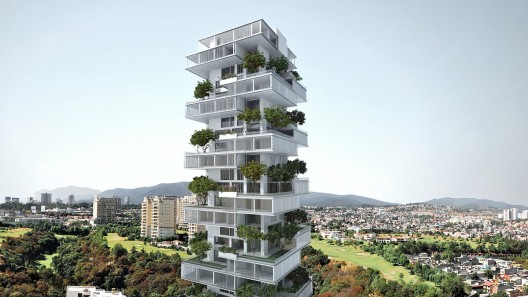
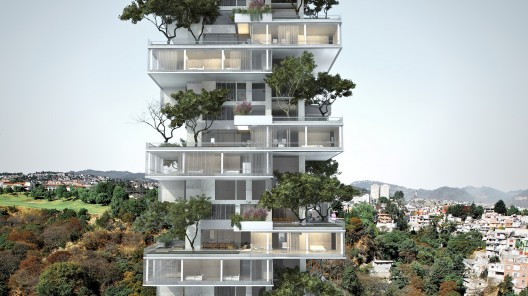
Meir Lobaton + Kristjan Donaldson recently shared their design for a 36 story residential tower in Mexico City, Mexico.   The project addressed the balance between the desire of living in a single-family residence with the cost of the land..
More images and more about the project after the break.
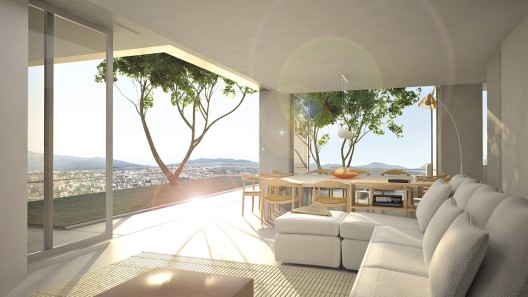
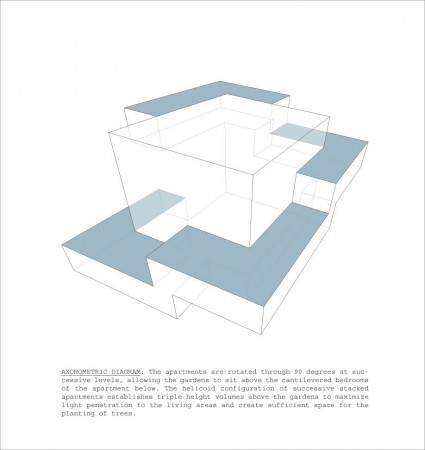
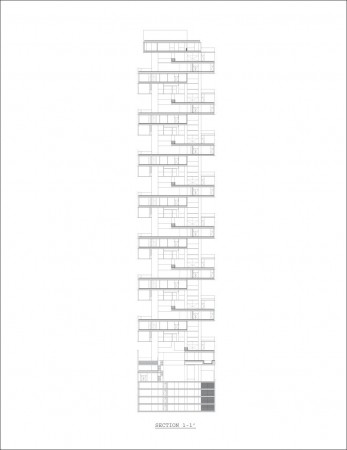
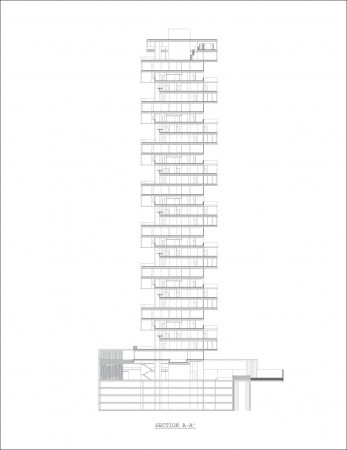
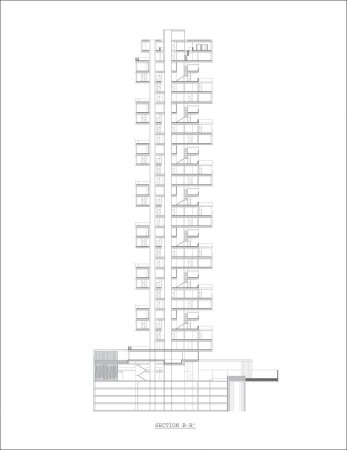
The residential tower provides the family the luxury of living in an apartment building without sacrificing the comfort of a backyard.  Gardens located on every level try to break with the dichotomy between land and building, and, more importantly, provide an area that is attractive and functional for the family members.
 
 
Each floor plan is organized around a single apartment type that is 400 square meters with a gardened
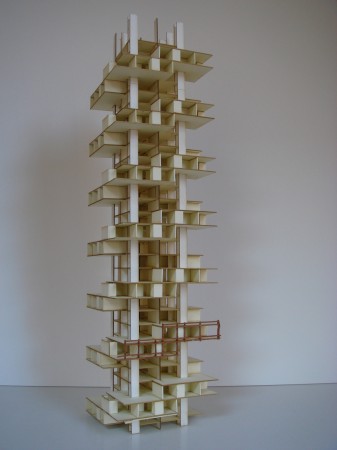
extension of approximately 160 square meters.  By rotating the apartments 90 degrees at successive levels, the gardens sit above the cantilevered bedrooms of the apartment below.
 
 
The shifting horizontal floor planes provide adequate space for full trees to grow. This shifting also balances the greenery, creating a blend of structure and nature, rather than allowing one element to dominate and the second to feel like an after-thought.  The internal living areas are organized to take full advantage of the gardens which adds a feeling of openness to the residences.
Due to the volatile seismic condition that characterizes Mexico City, a system of deep shear walls and Vierendeel trusses stabilizes the structure while accommodating the rotating floor plans.
TORRE CUAJIMALPA:
Location: Mexico City, Mexico
Program: Thirty-six storey residential tower
Area: 25,000 square meters aprox.
Designer/architect: MEIR LOBATON CORONA + KRISTJAN DONALDSON
Collaborators: Javier Sepulveda
Consultants: Garcia Jarque Ingenieros, SC., Buro Happold Consulting Engineers P.C.
date: July 2008 - March 2009
expected year of completion: December 2011
status of project: Design Development / Construction Documents
firm website: www.meirlobaton. com www.kristjandonalds on.com
renders: a-04 studio digital


Rolling Huts / OSKA Architects

Rolling Huts / OSKA Architects

Architects: Olson Sundberg Kundig Allen Architects
Location: Mazama, Washington, USA
Lead Architect: Tom Kundig, FAIA
Date of Completion: 2008
Size: 440 sf/per hut (200 sf interior space, 240 sf exterior deck)
Photographs: Chad Kirkpatrick & /Olson Sundberg Kundig Allen Architects
 
Tim Bies Chad Kirkpatrick  Tim Bies
 
Responding to the owner’s need for space to house visiting friends and family, the Rolling Huts are several steps above camping, while remaining low-tech and low-impact in their design. The huts sit lightly on the site, a flood plain meadow in an alpine river valley. The owner purchased the site, formerly a RV campground, with the aim of allowing the landscape return to its natural state.. The wheels lift the structures above the meadow, providing an unobstructed view into nature and the prospect of the surrounding mountains.
 

Tim Bies

Tim Bies

The construction of each hut is simple. It is, in essence, an offset, steel clad box on a steel and wood platform. Living occurs not only in the 200 sq ft inside the box, but on the 240 sq ft of covered deck space surrounding it. Interior finishes – cork and plywood – are simple, inexpensive, and left as raw as possible. Exteriors are durable, no-maintenance materials – steel, plywood and car-decking. The huts are grouped as a herd: while each is sited towards a view of the mountains (and away from the other structures), their proximity unites them. They evoke Thoreau’s simple cabin in the woods; the structures take second place to nature.


Oscar Niemeyer auditorium under construction

Oscar Niemeyer auditorium under construction

Completion is due in September, ready to showcase the new auditorium’s unique feature: its over-hanging canopied roof (or solaio a sbalzo in Italian). More plainly put, this means that while the amenities are set off the entrance piazza or in the floors below, a section of the 1,500m2 canopy, which contains the actual auditorium space, literally and strikingly, hangs in the air supported by nothing.
Seen at Wallpaper. More images after the break (we searched all over the web for more images, if you can find some, please post the links!)


Mirage by Kjellgren Kaminsky Architects

Mirage by Kjellgren Kaminsky Architects

miragetop2.jpg

Swedish architects Kjellgren Kaminsky have completed Mirage, a new dance hall in Falsterbo, Sweden.

mirage8.jpg

The building is divided diagonally by a two-storey high entrance hall from which all the public rooms can be accessed.

mirage15.jpg

It includes a dance floor, a bar, two restaurants, a kitchen, a performance venue and a roof terrace.

mirage29.jpg

The custom made acoustic dampening walls of the interior consist of black acoustic felt covered in variously-sized, white, wooden boards.

mirage26.jpg

The exterior is clad in graphite-grey, glass-reinforced concrete and mirrored glass.

mirage28.jpg

Located among pine trees near a beach, the new building replaces a 1930’s dance hall that was destroyed by fire in 2006; Kjellgren Kaminsky Architects’ design was the winning proposal in a competition that same year.

mirage19.jpg

Photographs are by Kalle Sanner.

mirage9.jpg

Here are further details from Kjellgren Kaminsky Architects:
Mirage
In 2006 Fredrik Kjellgren and Joakim Kaminsky won the international architecture competition for a new dance hall in Falsterbo, Sweden, and started their studio; Kjellgren Kaminsky architecture.

mirage10.jpg

When designing we always work with our manifesto which puts focus on people, needs and context. In special projects we write several short stories describing what could take place in the building. In the mirage project it was important to connect the conservative and historical mindset of the community of Falsterbo with the new ideas and visions that attracts young people from all over Europe to visit the area during the summer months.

mirage6.jpg

THE FIRE
The 30th of May 2006 the old dance hall in Falsterbo, Sweden, was destroyed by fire. The dance hall was situated 200 meters from the beach in a small pine wood grove on the southernmost tip of Sweden. Having been a famous meeting place for both locals and tourists since the 1930’s the dance hall was much mourned and it was soon decided that the house should be rebuilt. The municipality launched an international architecture competition that draw a record breaking interest from both media and architects. After careful consideration the jury decided upon Kjellgren Kaminsky’s proposal “Mirage”.

mirage7.jpg

ESTABLISH A DIALOGUE
The Mirage dance hall establishes a dialogue with the site, its history and future. Like a diffuse recollection it reflects the position and facades of the old dance hall while simultaneously reflecting its surroundings in every moment; the changing seasons, the light and the people passing by.

mirage3.jpg

INTERIOR
Much emphasis was put on designing spaces with extraordinary acoustic qualities. A custom made damping wall was designed in collaboration with an acoustic expert. The wall consists of a black acoustic felt covered by white wooden boards of various dimensions which creates strong graphical elements in the whole building. The wall has proven no more expensive than standard solutions.

mirage21.jpg

The old dance hall solely consisted of a dance floor and a bar, but for the new building the program was extended to also include two restaurants for 250 people, a kitchen, a room with a stage and a second floor with a roof terrace, adding up to a total of 1600 sqrm to host 1500 people.

mirage12.jpg

The plan of the new building has the same footprint as its predecessor. It is cut diagonally by a two story high entrance room which connects all the public areas in the building.

mirage2.jpg

The building is divided so that the serving spaces are placed along the eastern facade and the served public spaces are located on the west side. The rooms towards the southern facade opens up to terraces.

mirage22.jpg

NEXT TO NATURE
The building is situated in a nature reserve. The pine tree grove surrounding the building is kept unaffected. The terraces and paths connected to the building are made out of wooden boards taking there inspiration from the jetty’s on the nearby beach. A small gravel road for deliveries is lade out on the east side of the site.

mirage4.jpg

FACADES
The Facades of the building are clad in boards of graphite gray fibercement and mirror glass. The mirrors are placed in a pattern inspired by the wooden facade and windows of the old dance hall.

mirage5.jpg

CONSTRUCTION
The building is constructed with prefabricated concrete elements. This has not only proven an economically feasible solution, the heavy construction also helps keeping the noise inside, to the joy of worried neighbors living nearby.

mirage.jpg

FOUR STORIES:
The wedding
A party celebrating a wedding walks stiffly up the stairs to the upper floor restaurant. At the end of the stairs they are met by a framed view of the sea and the horizon. To the right welcoming drinks are being served in the bar.

mirage24.jpg

When turning one see big windows facing south, outside pine treetops point towards the sea. Between the horizon and the restaurant there is a generous terrace where the drinks are enjoyed. Later on the party will walk down to the first floor where a dinner will be served in the larger restaurant.
mirage16.jpg
Specular Sea floating deck
After a great day on the beach we can walk up under the pines on the wooden jetties to the restaurant’s terrace. While leaving the sea we are meet by the horizon and heaven in the reflecting mirrors.

mirage120.jpg

White parasol’s and furniture reminiscent of the happy 20’s, now that we can sink into the comfortable chairs and have a break to think about getting another ocean dip, or eat a delicious lunch and then cooling off with a cocktail in the bar.

mirage230.jpg

Dance Night
Several hundreds of people have gathered to enjoy an evening with the heavy tunes from the local brass band. From the stage music flows into the room. The dancing couples slowly begins to move in from the restaurant where they have enjoyed food and the last glare from the sun. People also moves directly from the entrance where they already have had a glimpse of the dancing people. This will be an intense evening.

mirage18.jpg

Disco
A long queue winds itself along the wooden deck into the entrance. The spirit among the young excited people is great, tonight is the summer closure and there will be a lot of people here. Three different dance floors with music mixed by DJ’s from Sweden, London and Barcelona. Inside the entrance room people stands, sit and mingle.

mirage27.jpg

The restaurant is filled with dressed up youngsters enjoying summer vacation and short drinks. At the long bar it is served summer drinks and a DJ turn her vintage vinyl records. At some tables, it has already become crowded and laughing friends tells stories of this summer’s escapades. Inside the dance room several hundred people move in ecstasy because of the escalation of the beats and the light show that flashes out across the large wooden floor.

mirage11.jpg

Up the stairs the atmosphere calms down and people sit at small tables, sips on their drinks in the bar or hang out in the VIP area behind the elevator. Smokers take a torch on the veranda outside.

mirage13.jpg

Bowkunde Proposal / Sid Wichienkuer

Bowkunde Proposal / Sid Wichienkuer

On May 13, 2008, Bouwkunde, the faculty of architecture building at Delft University, was unexpectedly consumed by a devastating fire. Before the incident, the building had created a social and education environment where ideas and criticism were shared freely.  The faculty saw this terrible loss as a positive opportunity to take a fresh and critical look at the education of the future.  Thus, an open international ideas competition was organized in 2009 for the design of a new building.  California-based architect Sid Wichienkuer’s proposal for the new building aims to restore the creative atmosphere Bouwkunde offered its users.
More images and further project description after the break.
“The rebuilding of the architecture school is an outward expression of the philosophy of the school stating that architecture will be relevant, will be involved with other academic communities in solving problems, and will seek a new sense of civic leadership,” Wichienkuer remarks.


The project seeks to understand how section can foster productive architectural relationships. By using topographies as a driving force, the building is organzied around a central quad. As the building rises, the communal interior core grows so that each floor is centered around a gathering space.  Due to the stacking of these communal spaces, the other programmatic elements such as offices, studios, and libraries, radiate outward to create a dense envelope that surrounds the users.


The ground level is extremely porous as to attract passerbyers to the space.  A large auditorium can be configured to accommodate multiple size as a gesture toward bringing all into the dialogue of the building.   The horizontal stepped pieces are spaced in such a way that allows students to climb up the building or use the space as outdoor seating.
For more about the architect..  As seen on archiCentral.

Zilverparkkade D / René van Zuuk Architekten

Zilverparkkade D / René van Zuuk Architekten

Architect: René van Zuuk Architekten
Location: Zilverparkkade D, Lelystad, the Netherlands
Client: Develop-Havelte, Lelystad
Design Team: René van Zuuk, Kersten Scheller
Master Plan: West 8, Rotterdam
Building Contractor: Ter Steege, Rijssen
Structural Ingeneering: Van Rossum, Almere
Project Year: 2002-2006
Budget: € 1,750,000
Site Area: 222 sqm
Constructed Area: 1,867 sqm
Photographs: Christian Richters
 
 
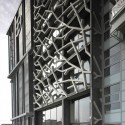
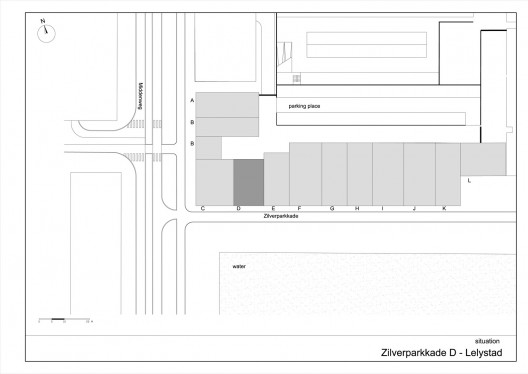
The project derives its romantic name (Silver Park Quay) from its location: the office cluster on the Zilverparkkade in Lelystad. West 8 designed the urban plan for the area in conformity with the current trend for condensed city-centres. With an idyllic wink to the 17th century Dutch canal-houses the offices are lined up shoulder to shoulder on narrow plots. In such a compact row with a strict layout the only elements to create a discriminating identity are the facades.
 

site plan

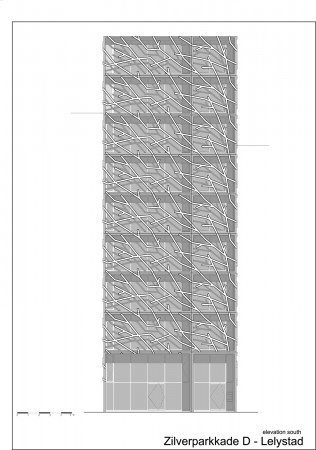
south elevation

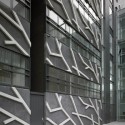
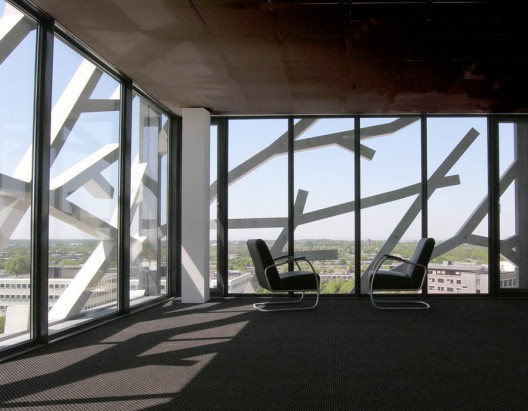
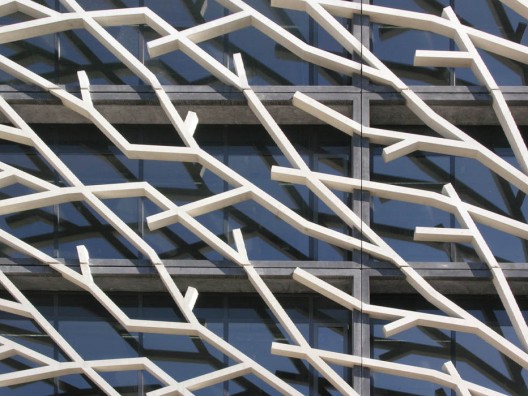
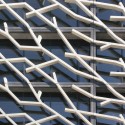
All four façade surfaces in the design are either entirely or partly covered with prefabricated concrete elements, symbolizing a branch-like structure. This blown-up filigree is the result of a study of infinite patterns. The works of the Dutch graphic artist Maurits Escher have been an unmistakable model. Specific skills are required to devise a repetitive pattern that, applied in a limited number of different concrete elements, constitutes a seamless entity. The craftsmanship needed to avoid the repeating units to be too obvious, has an analogy with designing rotation press patterns for textile and wallpaper.
 

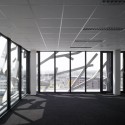
The façade structure continues around the corners, providing the office building a recognizable identity distinct from the adjacent properties. The south and west elevation have a double layer façade with window-cleaners’ ledges in between. A profitable side-effect of these narrow balconies is their function as a barrier to prevent vertical spread of fire. As a result storey high panes of ordinary (non-heat-resistant ) glass could be applied. The ledges also act as large sun protection slats. The branch structure provides an obscured vista from the outside, but from the inside the users hardly have any impairment of the view on the surroundings.
 

The concrete elements on the north and east façade are solid. The branch-pattern on these panels is applied in high relief en is highlighted by using two different shades of aggregates. The rear façade has an alternating structure of horizontal strips of textured concrete and windows, with a vertical cut splitting the building asymmetrically. This incision visualizes the zoning and subtly affects the repetition of the solid concrete panels.


The 10 Most Creative People in Architecture


The 10 Most Creative People in Architecture

 
Cliff Kuang from Fast Company has ranked the 10 most creative people in architecture. That doesn’t mean they’re the best, just the most unusual and influential visions in the field.
Be sure to check the architect’s works published on ArchDaily!
The complete list after the break.
 
1. Will Alsop, ALSOP Architects
 
ALSOP Architects
 
2. Yansong Ma ,MAD Architects - (projects on AD)
 
MAD Architects
 
3. Insuk Cho and Kisu Park, MASS Studies - (projects on AD)
 
MASS Studies
 
4. Rem Koolhaas, OMA - (projects on AD)
 
OMA
 
5. Winy Maas, Jacob van Rijs and Nathalie de Vries, MVRDV - (projects on AD)
 
MVRDV
 
6. Shigeru Ban, Shigeru Ban Architects - (projects on AD)
 
Shigeru Ban Architects
 
7. Jacques Herzog and Pierre De Meuron, Herzog & De Meuron - (projects on AD)

Jacques Herzog and Pierre De Meuron

Morphosis Architects

 
Zaha Hadid Architects
 
10. Norman Foster, Foster + Partners - (projects on AD)

Foster + Partners

'Faceless' Science Museum redesigned

'Faceless' Science Museum redesigned


Designs to pull the UK home of technology into the 21st century

Plans revealed for the redesign of the ‘faceless’ Science Museum on London’s Exhibition Road are to recreate the space as a ‘Museum of the Future’, aiming for completion by 2015.

As part of a wider regeneration of the Exhibition Road revitalisation as the ‘cultural heartland of London’, the Science Museum will undertake a redevelopment designed by Wilkinson Eyre Architects which incorporates a new facade, new galleries, lifts and SkySpace - a cavernous rooftop space and 'destination cafe' dedicated to cosmology. “I really like the concept that there’s so much going on in the museum that they’re kind of fighting to get out,” says Paul Baker, Wilkinson Eyre Director and architect for the project. He is describing the Beacon, the glass and light façade set to burst out from within the existing columned entrance. Acting like a lighthouse for the Museum, the Beacon will allow the building to be acknowledged from either end of Exhibition Road and create an entrance to inspire and excite visitors. Its underbelly will act as a screen entertaining and enticing visitors. The redesign is an extension of the partnership between Wilkinson Eyre and the Museum which has developed over the past 15 years as they have collaborated on the ‘Museum of the Future’ framework devised to bring the museum through into its centenary year. “We’ve enjoyed working with Wilkinson Eyre in the past as they are one of those firms that work in a space between art and technology,” says the Museum's Head of Creative Direction, Tim Molloy. “They bring a vivacity to engineering which we very much enjoy.” The redesign celebrates the Museum’s centenary year and is seen as an opportunity to pull the museum into the 21st century. Molloy explains that it is also a chance to change perspectives: “We’ve always been known as a museum that’s interactive, really for the last 100 years. Where you can see things as well as do things. That’s something that has been commonly misinterpreted as being about kids...that’s something we want to change to show that it’s about creating conversation.” On a functional level, the new design will resolve acknowledged movement issues upon entering and within the building. “The building is made up of a long thin sequence of spaces culminating in the welcome wing. The idea was that we created some visual identity between floors. As you go deeper into the building you kind of lose the identity of the different floors,” said Baker noting that the visitor tends to work across the ground floor. “The way we worked here is we made a computer model of the building. We looked at the shapes and relationships all down the building and worked out how we could manipulate them.” Part of this manipulation is the inclusion of three new lifts which encourage upward circulation. The entrance will also be opened up with multiple entrances reducing the bottleneck effect previously suffered.

The project will be progressed through several stages commencing with the creation of the Beacon and culminating in SkySpace which will commence circa 2013. Before these works can commence, however, the big push is on gaining funding for the project. Molloy advises that despite current economics, he is confident about this challenge: “I’m always very positive about recessions. I think a period of restraint is very good for creativity. It allows you to reflect and allows us to be future focused…One of the things to guide us out is science and technology and we are confident that this is something that people will invest in.”


A hall for peace

A hall for peace


Orb design to honour Ban Ki-Moon

The project of the UN Peace Park was initiated by the City of Chungju in honour of the current General Secretary of the United Nations Organization and native of Chungju, Ban Ki-Moon. The project will be the new cultural landmark for the city, spreading out along the banks of the river Namhangang and to the north of the Natural Park Tangeumdae. This cultural aspiration culminates in the design of the new UN Memorial Hall, creating a new landmark building for Chungju.

The UN Memorial Hall is an ellipsoidal building with a maximal diameter of 60m. It is made of 8 storeys and 1 basement floor. The heart of the building is the 1,500 seat auditorium and auxiliary conference spaces. The auditorium will offer a view to the outside direction of the Tangeumdae Natural Park. Spiraling upwards, the continuous ramp houses an exhibition explaining the history of the United Nations between 1945 and today, finally culminating in the Gallery of the General Secretaries. The human being, center of interest of the United Nations mission will be the protagonist and integral part of the architecture and appearance of the UN-Globe. The UN-Globe will be placed in an orchard of 192 apple trees representing the number of member states of the UN.

The focal point of this project is the city of Chungju, in miniature, in the heart of the site. This point has been defined as the epicenter of the concentric orbits which create a unifying surface for the different events of the park, like the Stone Collection (Suseok), the research center, and a number of other follies.


Ruy Barbosa Labor Courthouse / Decio Tozzi

Ruy Barbosa Labor Courthouse / Decio Tozzi

Architect: Decio Tozzi
Location: Sao Paulo, Brazil
Architects in Charge: Decio Tozzi & Karla Albuquerque
Square’s chromatic panel: Decio Tozzi
Artistic panel in the auditorium: Claudio Tozzi
Structural engineers (concrete): SVS Engenharia
Structural engineers (steel): Jorge Zaven Kurkdjian, Jorge Kurken Kurkdjian
Fundations: Consultrix
Services: MHA Engenharia
Construction: Construtora Incal / Construtora OAS
Site Area: 15,228.91 sqm
Constructed Area: 124,000 sqm
Conclusion date: 2004
Photographs:
Cristiano Mascaro
 
 
The traditional buildings for courthouses up to the beginning of the twentieth century, designed according to the conceptual ideas of the Grand Prix de Rome, were distinguished by their formal structures inspired by classical architecture and conveyed the idea of sumptuous monumentality.
Furthermore, solemn spaces expressed an Apollonian aspect that not only indicated the austerity of Power but also its authority as if this authoritarian image of Justice coincided with the image of a society which was also authoritarian.
 

The great solemn halls of Justice, the Salas dos Passos Perdidos, exhibited this monumentality not only through the scale of the building but also through the use of sumptuous construction materials.
The conceptual issue underlying the design of this courthouse was how one may propose, within a democratic metropolitan post-industrial society, a new formal structure, a semantic expression of such an important type of public building architecture and at the same time to make its insertion in the city capable of expressing a singular relationship carrying both meanings, that is a metaphor of the metropolis in itself.
The centralization of the several sections of the Labor Courts previously scattered throughout the city and its ensuing verticality, conquering air space, comprised the first guideline towards the proposal of a vertical architectonic concept.

The design of the building, following this vertical axis, organizes the four blocks of the courts, two by two, separated by double height empty spaces where collective support activities pertaining to the daily life of the judiciary complex take place.
This vertical concept gives shape to a great central empty space designed to integrate the whole complex. The unlimited visibility and full spatial integration due to the spatial fluidity bestow the necessary transparency that the bureaucratic activities require, and offer to the administrative sections of the building a global appreciation of the work being done, and the necessary rationality inherent to these activities.

This generous 50 m by 50 m area has transparent walls and roof and becomes a new access and distribution space, a feature of integration for the whole courthouse complex.
The previous solemn hall, authoritarian and majestic, finds a new meaning: the Law Square, designed to represent a new square for the city of São Paulo. On the ground floor level there is a restaurant, a bank, a telephone center, a post office, a bookshop and a 500-seat auditorium which is open to the community.
The vertical circulation is made through twenty fast lifts, four of which are restricted to the private use of the judges. All the floors are interconnected with a system of multiple ramps that very effectively comply with the required circulation of approximately 20,000 people per day.

The glass roof covering the Law Square is placed at the height of 72 meters above the ground floor level, and was treated as a feature of modular design that has the characteristics of a muxarabiê suspended in the air, an effect obtained simply through the alternation of different polyvinyl butyral interlayers - a sunlight controlling panel within the square space.
Since it was so designed the space configures a new square in the city of São Paulo due to its scale and volumetric configuration - a square bathed in sunlight but protected from rain and wind, proposed as a meeting place,a space for social intercourse and harmony between peoples.


Bowkunde Proposal / Sid Wichienkuer

Bowkunde Proposal / Sid Wichienkuer

On May 13, 2008, Bouwkunde, the faculty of architecture building at Delft University, was unexpectedly consumed by a devastating fire. Before the incident, the building had created a social and education environment where ideas and criticism were shared freely.  The faculty saw this terrible loss as a positive opportunity to take a fresh and critical look at the education of the future.  Thus, an open international ideas competition was organized in 2009 for the design of a new building.  California-based architect Sid Wichienkuer’s proposal for the new building aims to restore the creative atmosphere Bouwkunde offered its users.
More images and further project description after the break.
“The rebuilding of the architecture school is an outward expression of the philosophy of the school stating that architecture will be relevant, will be involved with other academic communities in solving problems, and will seek a new sense of civic leadership,” Wichienkuer remarks.


The project seeks to understand how section can foster productive architectural relationships. By using topographies as a driving force, the building is organzied around a central quad. As the building rises, the communal interior core grows so that each floor is centered around a gathering space.  Due to the stacking of these communal spaces, the other programmatic elements such as offices, studios, and libraries, radiate outward to create a dense envelope that surrounds the users.


The ground level is extremely porous as to attract passerbyers to the space.  A large auditorium can be configured to accommodate multiple size as a gesture toward bringing all into the dialogue of the building.   The horizontal stepped pieces are spaced in such a way that allows students to climb up the building or use the space as outdoor seating.
For more about the architect..  As seen on archiCentral.

Roosendaal Market Square Pavilion by René van Zuuk Architekten

Roosendaal Market Square Pavilion by René van Zuuk Architekten
 

roosendaalpaviliontop2.jpg

René van Zuuk Architekten have completed a pavilion for the pedestrianised central market square at Roosendaal in the Netherlands.

roosendaalpavilion7.jpg

The pavilion, built over the entrance to an underground car park, features a rooftop performance area.

roosendaalpavilion14.jpg

The pavilion also houses shops and offices.

roosendaalpavilion15.jpg

The pavilion and car park are elements of ongoing improvements to the square, which was pedestrianised in 2001.

roosendaalpavilion8.jpg

Over the main car park entrance, the cantilevered south aspect of the pavilion allows natural light to penetrate the two underground levels.

roosendaalpavilion3.jpg

Here’s further information from René van Zuuk Architekten:
In 2001 the city of Roosendaal (a provincial town in the southwest of the Netherlands) decided to ban cars from the New Market in the centre of town by building a huge two storey underground parking.

roosendaalpavilion2.jpg

In order to create a new public square the city of Roosendaal asked the urban design office Quadrat to make a proposition.

roosendaalpavilion6.jpg

In their scheme they proposed to pave the square with red and brown brick, plant 15 trees, make three exits for the underground parking and as the most visible and important element they proposed a restaurant and coffee  pavilion in the form of an oval.
roosendaalpavilion12.jpg
In 2005 a public design and construction bidding for contractors was organised. Just before they had to submit their entry to the city, the municipality decided to include the pavilion as well.

roosendaalpavilion5.jpg

Therefore they asked the office of Rene van Zuuk to make a design for the pavilion including the contract drawings over a very short span (5 weeks), due to these limitations there was no time to make big changes in the urban scheme and the location and the form of the pavilion was copied from the original urban proposal.

roosendaalpavilion10.jpg

The idea behind the urban proposal was that the pavilion would divide the square in two parts in such a way that you would still have the feeling of being on one big square.

roosendaalpavilion9.jpg

Because of the market activities which occupy the entire square twice a week, the terraces of the pavilion needed to be placed above the ground floor.

roosendaalpavilion1.jpg

Originally the terraces could only be reached by going through the pavilion.

roosendaalpavilion4.jpg

Rene van Zuuk decided to make the terraces accessible from the outside of the building as well so you can walk from the square up onto the sloped roof to the terraces letting the roof become a public area.

roosendaalpavilion16.jpg

The entrances from the roof to the building are made by cuts in the sloped surface giving every floor its own terrace.

roosendaalpavilion18.jpg

The rest of the roof acts as a big stage which allows artists to give a performances in front of the building.

roosendaalpavilion19.jpg

On the south side the pavilion reaches its highest point. This part of the building cantilevers over the main entrance of the parking garage allowing daylight to penetrate deep into the two levels below.

roosendaalpavilion20.jpg

In order to make the cuts in the roof and to accommodate the cantilevering part of the building, the structure is made by a simple braced steel grid of 4.2m x 4.2m and 3 m high.
roosendaalpavilion21.jpg
The orientation of the grid coincides with the location of the entrance of the main shopping passage. This results in a new direction on the square making the space more dynamic.

roosendaalpavilion22.jpg

The original square dates from just after the war until the 1970’s, the architecture was cold and the color monotonous. The new urban scheme is warm in nature thanks to the trees and use of brick.

roosendaalpavilion23.jpg

It was obvious that the pavilion should  blend in with this character and therefore wood was the most appropriate choice of material.

roosendaalpavilion24.jpg

Because the quality of most of the original buildings around the pavilion is not that high, the urban scheme and the new pavilion have to work together as a catalyst to upgrade this part of the city.

roosendaalpavilion25.jpg

Location: City Center Rossendaal  / NL
Client: Gemeente Roosendaal / NL
Program: Pavilion – shops/lunchroom/ office / entrance for parking area

roosendaalpavilion26.jpg

Office: René van Zuuk Architekten b.v., Almere  / NL
Design: René van Zuuk
Members of the design team: Jorrit Spel, Chimo Villa Belda

roosendaalpavilion27.jpg

Usable floor area: 620 m2
Built-up area: 518 m2

roosendaalpavilion28.jpg

Start of design: 06/2005
Completion: 06/2009

roosendaalpavilion29.jpg

roosendaalpavilion30.jpg

roosendaalpavilion32.jpg

Kindergarten Sighartstein by Kadawittfeldarchite ktur

Kindergarten Sighartstein by Kadawittfeldarchite ktur

kindergarten-sighartstein-by-kadawittfeldarchitektur-1.jpg

German practice Kadawittfeldarchite ktur have completed a kindergarten in Sighartstein near Salzburg, Austria, clad with metal elements designed to look like blades of grass.

kindergarten-sighartstein-by-kadawittfeldarchitektur-5.jpg

This green ornamentation shelters the upper floor of the two-storey building and is made of powder-coated aluminium.

kindergarten-sighartstein-by-kadawittfeldarchitektur-3.jpg

The building houses a kindergarten on the ground floor with access to the gardens and floor-to-ceiling windows.
A crèche is on the first floor, sheltered from bright sunlight by the external cladding.
 
kindergarten-sighartstein-by-kadawittfeldarchitektur-7.jpg
 
The staircase and hall have a green, natural-rubber floor and are used as multi-functional, shared areas.

kindergarten-sighartstein-by-kadawittfeldarchitektur-8..jpg

Photographs are by Angelo Kaunat.

kindergarten-sighartstein-by-kadawittfeldarchitektur-9.jpg

Here’s some more information from Kadawittfeldarchite ktur:
Kindergarten Sighartstein – Can you hear the grass growing?
BRIEF A kindergarten integrated into the landscape like a chameleon (including a crèche) for 4 groups
ADDED VALUE Genius Loci – the first impression of this place in the midst of green meadows and fields leads to the concept of the built playground. The elevated and abstractly stylized “grass” facade of the cubic building brings a certain harmony to the volume as well as an identity and orientation for the kindergarten.

kindergarten-sighartstein-by-kadawittfeldarchitektur-12.jpg

The inner organization follows the logic of use: kindergarten groups have open access to the gardens while the crèche groups are kept safe in the floor above. The mid-point of the building is the multifunctional “interactions space” - a public communication area located at the intersection between functions.

kindergarten-sighartstein-by-kadawittfeldarchitektur-11.jpg

Spatial dimension of the ornamental facade
Situated on the periphery of the site of green meadows and fields, the first impression of the construction site provided the idea for the sculptural facade by way of an elevated grass turf. The oversized “grass blades” communicate the building’s unique identity and provides an orientation marker for the kindergarten. The stylized grass blades are not only ornamental, but also act as a continuation of the landscape theme – namely, the staccato row of spruces visible at the meadow’s edge or the branches of the neighboring leafy trees. The resulting scenic correspondence takes place not only in the building volume itself but also in the structure noticeable from within..

kindergarten-sighartstein-by-kadawittfeldarchitektur-2.jpg

The flat roofed two-story cubic building optimally distributes the functions of a kindergarten. On the ground floor, one finds the space for the kindergarten groups - with direct access to the garden. The crèche is accommodated in the protected upper story. In the crèche, an expandable third space has been made possible through a planned reallocation of the space. The core of the building is a multi-functional hall – a communicative center for children and caretakers, used as a junction for various functions: a space for shared activities and an alternative space for bad-weather activities.

kindergarten-sighartstein-by-kadawittfeldarchitektur-17.gif

Coloring
The space of the kindergarten, over the course of time, will be filled with colorful children’s things, furnishings, materials and first works. Thus, we consciously reduced the color spectrum to the single tone variation of ‘green grass.’ The multi-functional space unfolds itself in the building interior.. Various shades of green take up the grass theme to define the individual areas.
The group rooms are lined up along the south side with direct access to the terrace and garden. The group rooms are comprised of two units – each with a wardrobe, sanitation area, and a storage space located in between the hall and the group areas. To the east are additional rooms such as the personnel area, administration, quiet room and mess hall.
kindergarten-sighartstein-by-kadawittfeldarchitektur-16.gif
Color Concept
As the kindergarten is the first station of education, we have chosen green as the ‘color of life, youth, and spring.’ The psychological workings of the color green play an important role: Green is a color that calms and harmonizes. Green enhances qualities such as helpfulness, endurance, tolerance, and contentedness. In color therapy, green is viewed as a neutral healing color that balances without causing bodily pain or counter-reactions. It creates a space for gathering energy and promotes regeneration. In earlier times, the color was one of the most favored for living rooms and salons. Blackboards in schools are green because the color is easy on the eyes and serves as a contrast to other colors, allowing one thus to better concentrate on the essentials. Green conveys the notion of freshness and youth, but also immaturity. It’s not for nothing that the root of the word ‘green’ lies in the old Dutch word “groen,” meaning grow and flourish.
Green as the stage of childish curiosity: CAN YOU HEAR THE GRASS GROW?!
Children learn by playing – and when they can do this in a relaxed atmosphere, quiet and fully concentrated, we lay the foundation for every form of learning later in life, for the concentration that is so essential.

kindergarten-sighartstein-by-kadawittfeldarchitektur-15.gif

Light + Nature
The floor-to-ceiling glassed-in ground floor invites nature straight into the building by lighting up the group rooms with plenty of sunlight; whereas the window openings of the upper level behind the ornamental facade create a completely different lighting and provide the youngest users of the crèche with an atmosphere of nurturing shelter.

kindergarten-sighartstein-by-kadawittfeldarchitektur-14.gif

Approval
The feedback thus far from the educators and the community itself has been extremely positive. Since the handover at the end of March, the kindergarten has been used by the children and the hall, including the large free-standing staircase, has been played on extensively – proving that the natural rubber floor covering serves its purpose well. Those who were initially skeptical and critical of the choice of color are now enthusiastic supporters of it, even the municipal director.
Next to the illustrated cardboard house, there are many further illustrative works of how the architectural structure of the house is played with.

kindergarten-sighartstein-by-kadawittfeldarchitektur-13.gif

Location: Sighartstein, Land Salzburg (AT)
Builder: Township Neumarkt am Wallersee
Realization: 2008 - 2009, Public competition 2003, 1st prize
Building Volume: NGF 830 m2, BRI 3.665 m3
Construction sum: 1.2 Million €
Photographer: Angelo Kaunat, Salzburg
Construction:
Reinforced concrete building
Cladding:
thermal insulation composite system
low-emission and noise control glass in windows
and post-and-beam contruction
exterior sunscreen in the color of the thermal insulation composite system
curtain wall powder-coated aluminum ornament
greened flat roof / extensive vegetation layer
sun panels on the roof area
Planer:
kadawittfelarchitek tur
Aureliusstr. 2
Aachen, Germany
52064
Project Manager: Arch. DI Kerstin Tulke
Deputy Project Manager: Arnd Schüle
Public competition: Oliver Venghaus, Sebastian Streckel
Builder:

Commanding design for sea resort

Commanding design for sea resort


BBG-BBGM completes fortress-like design of Montenegro Resort

Designed by BBG-BBGM, The Astra-Montenegro Tower and Wave buildings function as the dramatic centerpiece of a bold new five-star luxury mixed-use development in Budva, Montenegro. The project site, a wooded, steeply sloping peninsula along the Adriatic Sea separating the Budva and Bicice waterfronts, represents a coveted piece of this rapidly-developing region and demands an iconic form of equal drama. In order to fulfill this, BBG-BBGM's design concept involves weaving a dialogue between two complimentary forms: the iconic sail-like Tower and the attached low-rise Wave building.

The 26-storey tower building is gently curved in plan and elevation, evoking the image of two sailboats racing across the bay below. The building’s north and south ends are split to reinforce the vertical articulation of the mass into two competing exterior 'shells'. A taut, unitized glazing curtain wall system at the ends of the building is met by gently curving balconies, clad with a fritted glass rail. The inset walls at balcony level are double glazed storefront glass with sliding doors. Anodized metal panels on the face of the building visually separate these primary architectural elements. A series of horizontal anodized metal fins with back-lit glazed panels illuminate the cap of the building’s “sails.” The base of the Tower is anchored with limestone slabs that step out of the exposed rockface, sloping dramatically to the Adriatic Sea. The entry pavilion is glazed in a structural glass system to allow maximum inside/outside visibility, and creates a separate arrival experience and identity for the residents. In contrast to the Tower, the Wave building is linear in nature, terraced into the side of the slope. The Wave’s defining architectural expression is created by a continuous sweep of serpentine balconies. The balconies are faced in a rain screen panel and a projecting sunscreen of anodized metal louvers. The Wave’s western façade is glazed with continuous balconies overlooking the Budva Riviera, while the longer eastern façade consists of a wood panelized rain screen system. The length of the eastern wall is broken up with projecting stair and lift elements that reveal themselves through backlit frosted glass panels. The Wave’s units are accessed by a series of serpentine single loaded corridors allowing all units to be oriented to the waterfront.

Together, the Tower and Wave buildings contain a total of 454 luxury residential units and 128 hotel units.


Cairo Expo City / Zaha Hadid

Cairo Expo City / Zaha Hadid

We were just informed that Zaha Hadid Architects will be designing the Cairo Expo City, together with multi-disciplinary engineering consultancy Buro Happold, after a two phase competition.
This project follows the recently announced Stone Towers by ZHA in Cairo, Egypt.
The new Cairo Expo City will provide a facilities suitable for the international conference and exhibition industry, making Cairo more competitive in a global scale.

The facility will be located between the city and the airport. The project includes 450,000sqm for exhibition and conferences, and also two office towers (31 and 33 stories each) and a shopping centre.

A carving and sculpting process (related to the strong relation of the country with the Nile) has been used to divide the large exhibition and conference areas required for Cairo Expo City into clusters of individual buildings that have their own formal composition, yet each building relates to the overall design. A main north-south artery is carved through the design, with secondary streams converging at the centre to ease crowd traffic during event. The movement of people within these streams informs the building entrances on the site.
 

Works on site starts o

Digital origami

Digital origami

digital-origami-by-aka-architetti-8.jpg

Rome architects AKA Architetti have won a competition to design a television and learning centre in Italy with this design, entitled Digital Origami.

digital-origami-by-aka-architetti-1.jpg

The design will be built in the former Italcitrus packaging plant in Reggio Calabria, Italy.

digital-origami-by-aka-architetti-0.jpg

The complex will comprise television and audio-visual production facilities, as well as exhibition spaces for temporary installations and film festivals.

digital-origami-by-aka-architetti-2.jpg

The project involves restoring four of the six existing buildings, demolishing the other two and construction a new, semicircular building with a piazza at its centre.

digital-origami-by-aka-architetti-3.jpg

The new structure will be covered with a mesh, illuminated at night to project messages to the surroundings.

digital-origami-by-aka-architetti-4.jpg

The ground floor will house studios, laboratories, workshops, administrative offices and exhibition spaces, while the first floor will include a cafe, bookshop, offices and classrooms, open to the public.

digital-origami-by-aka-architetti-5.jpg

Here’s some more information from AKA Architetti:

International competition – First Prize

Digital Origami

The intervention represents a distinct urban and landscape sign. Not only the broadcasting antenna and the new building but also the entire complex as well as the surrounding terrain were sculptured and were intended to be a piece of land art.

digital-origami-by-aka-architetti-6.jpg

During the night the centre is engulfed by an illuminated net that emerges from the terrain spreading and arriving to the top of the broadcasting antenna/sculpture, visible from afar. The centre it self becomes an instrument of communication, an interactive device and not only a passive container. The Net that enwraps the centre has another function as a bio climate skin. It has bi phase ecologic system; passive, hot/cold protection, and active, with the insertion on photovoltaic panels.

digital-origami-by-aka-architetti-7.jpg

The distribution plan for the new complex is divided in 2 levels, on the ground level are located the more operative spaces, scenographic and tailoring workshops, laboratories, studios, administration offices and in the corresponding new building area an exhibition gallery. On the level above are the public designated areas such as the cafeteria, bookshop, offices and teaching classes. On the same level a suspended visiting path is programmed in order to allow the visitors to view the various activities without interfering.

digital-origami-by-aka-architetti-9.jpg

On the non built areas is planned an equipped public park that participate in the centre activities, the terrain is sculptured in a fractured way that allows to collocate the parking areas and the technical rooms underneath it.

digital-origami-by-aka-architetti-10.jpg

The competition was announced on April 2008 with the submission deadline on September 2008, the jury decision was publicly announced on March 2009. The project contract is foreseen to be held near the end of 2009. The construction timeline stands on 18 months.

“Ce.Te.S” International Competition For An Experimental Television Cultural/Didactic Center In The Former Italcitrus Packaging Plant In Reggio Calabria, Italy.

Organizers: Reggio Calabria local authority.

Development cost: 6.650.000 €

Area: 10.200 sq m

AKA ( AKA - Caccavale, Casadei, Pineschi Associated Architects)

Design team: Federica Caccavale, Alessandro Casadei, Paolo Pineschi, Nadav Engel

Punta Umbria Pavillion

Punta Umbria Pavillion / MRDP Arquitectos

In late 2008 the City of Punta Umbria, located on the coast of Huelva, Spain, organized a Competition for a Congress, Exhibition and Fairs building. MRDP Arquitectos sent us the winning entry.
 
The results:
1st Prize: FARO; MRDP Arquitectos | María Romero y Daniel Pérez
2nd Prize: CÓNCAVO-CONVEXO; Joaquín Aramburu y Asociados
3rd Prize: BI.VALVO; JOSÉ ÁLVAREZ CHECA
 

The plot is 7500 sqm, the maximum permitted occupancy is 70% and the area suitability for building is 7,500 m2 above ground. In the plot is planned to find archaeological remains to be integrated into the project.

The project

We intend to create a building to distinguish the City of Punta Umbria from others of similar size in the environment that contain similar facilities for fairs, exhibits, congress and shows.
 
 
ground floor plan
 

The project is organized around two main ideas:
From a programmatic point of view, we believe that Fairs and Exhibitions Pavilions samples becomes an inert, almost residual, in the hours and periods without activities. Therefore, we articulate the project around a plaza as a stimulus and an urban object, which may give the area more life regardless of the timing of the activities it contains.
 

Moreover, from a formal point of view we generate a unlimited flexible topography, where any changes did not compromise the character of the proposal. A building that moves away from conventional forms of fairs and exhibitions containers, flexible with itself and the area to be implanted, confused at times with it.
 
The new topography will contain the required activities under a green roof. The excess cost of such roof will be offset by savings in the acclimation of these large-scale spaces with an enormous thermal inertia.

The green roof will be covered by native hydrophilic species, resistant to weather and with poor maintenance. Part of the roof will be occupied by pedestrian paths connecting archaeological items that are expected to be found at the site.
 
We provide the building with a whimsical and unique 17m tower, as a lighthouse that will allow a visual connection to the river and its surroundings next to the building. This tower will contain small conferences and V.I.P rooms.
 
The Architects sent us a KMZ file, so you can see the project on Google Earth.

Elevation 02                      Section 01                           Section 02

Matchbox / Allard Architecture

Matchbox / Allard Architecture

Allard Architects shared with us Matchbox, their latest building in Amsterdam, The Netherlands, that just got approved by the Amsterdam Aesthetics Committee. Completion expected for December 2010.
 
Architect’s description and more images after the break.


The Matchbox is an blend of artistic, creative and commercial spaces. The building is shaped specifically as a result of the accommodation of companies and zoning regulations. It houses 22 corporate units, a rooftop restaurant and semi-underground parking in the artistic hub of Amsterdam North. The building lends its playful façade that sticks out cantilevers up to 5 meters, to each unit being individually angled and stacked on top of another to give every company its own space and identity. Bridges constructed above a central atrium garden act as catalyst for the networking between companies while distributing sunlight through the building.
 
Especially well-suited to start-up businesses, themed rent is an ideal way of promoting networks and building strong links within a wider industry. Originating in the arts sector, themed rent is now spreading to meet demand from elsewhere. The rotated nature of the units of the Matchbox merge with its simple large windows framed in black borders recalling a strip of film negatives.
 

section

 
The Matchbox building will be made of prefabricated concrete. The bent faces of the cantilevering boxes are constructed in prefabricated concrete walls. The hang not on a structural core but on the structural shear walls.. This effect completes shape of the stacked boxes. Use of steel in this building structure is minimised. Except the internal light non-structural walls have a galvanized steel finish. In their interior this enabling tenants to use the wall to pin up their work using magnets. The black frames around the boxes are constructed in folded aluminium elements glued on stiff insulation. Frames are shoved over the edges of the concrete floor. All the other grey coloured exterior surfaces are sealed with a seamless Poly-Urethane finish, spray on.


The project got slightly slowed down by the financial issues last autumn. But at this moment, due to private investors’ faith, the process is fully ongoing. This positive faith was created by good control concerning the building costs, lowering the costs for future rent. City councillors and the local project office ‘Noordwaarts’ for the neighbourhood showed many positive responses, wanting the Matchbox to boost up the energy in the area. All to keep supporting the creative industries in this trendy neighbourhood. . Remarkable is the fact that the Amsterdam committee for building aesthetics recently approved the whole plan for the Matchbox building, including its cantilevers. Building completion is expected on December 2010.


Credits:
Everything in this process is kept within its limits also the advisors’ team, all to keep on going and realize this extraordinary project in Amsterdam. Dutch companies as Van Rossum is on structural engineering, DGMR and LaRotonda are responsible for building regulations. The Allard Architecture office is based in Amsterdam. Allard’s co-workers in the architectural team are Jurriën Boon, Daniël Bakker and Cruz Garcia Santiago.
 
Gross Floor Area: 6,400 sqm
Bldg. Scale: 22 business units between 80 sqm and 250 sqm Rooftop restaurant with rooftop terrace.
Building Cost Estimate: €7.040.000
Design Team : Allard Meine Jansen- bna- architect director, Jurriën Boon-project Architect, Daniël Baker-technical manager, Cruz Garcia Santiago, Jennifer Gauthier, Roderick van der Weiden, Jeroen Linnenbank, Jan Nauta
Design Office:
Allard Architecture b.v.
Structure: Van Rosssum Raadgevende Ingenieurs
Max.Height: 24m
parking lots: Parking garage 1,150 m² (40 parking spaces)
Exterior Finish: Seamless Sprayed Polyurethane
Completion period: December 2010

The Amazing Avenel House in Victoria, Australia

The Amazing Avenel House in Victoria, Australia

Situated on an expansive property overlooking the vineyards in Central Victoria in Australia, the Avenel House by Paul Morgan Architects definitely gets its roots from the rural setting and the granite hillside. With an absolutely brilliant contrasting sense of mass and lightness, the four-bedroom house has a stone-founded basis, a light metal skin and a lot of glass that offer amazing sights of the landscape. Finely finished with contemporary furniture, some exquisite parquete and fireplace to add some warm to the whole itnerior, that’s definitely a place we could very well spend ourwhole  life in.

avenel-house

avenel-house

avenel-house

avenel-house

avenel-house

massimiliano fuksas: mab zeil to open on february 28th

massimiliano fuksas: mab zeil to open on february 28th


'mab zeil' in frankfurt, germany designed by massimiliano fuksas will open on
february 28th. the building which took approximately  5 years to construct is
comprised of  a 4 star hotel with conference centre, a fitness centre, a cinema
and office space.

fluent in form the building is connected by 2 major poles one at the zeil side
and the other at the TT side, where entrances are located for the hotel and offices.
the hotel's lobby is located in the reconstructed TT building, next to an art gallery
and the more luxurious shops that form the end of the shopping mall. the lobby is
connected with the rooms via elevators. in between there are connections on the 3rd
and 4th floor with the conference centre and sport facilities. escalators bring employees
up to the fourth floor in a 27.5 meter entrance hall.


Urban Mediaspace by Schmidt Hammer Lassen

Urban Mediaspace by Schmidt Hammer Lassen

 
urban-mediaspace-by-schmidt-hammer-lassen-0.jpg
 
Schmidt Hammer Lassen (SHL) architects have won an international competition to design Urban Mediaspace, which will be the largest public library in Scandinavia.
 
urban-mediaspace-by-schmidt-hammer-lassen-1.jpg
 
Urban Mediaspace will be realised on the waterfront at Aarhus in west Denmark.
 
urban-mediaspace-by-schmidt-hammer-lassen-2.jpg
 
The library is intended as a social hub, not just a place to house books. It has interior and exterior recreational spaces and the capacity to double as an event space.
 
 
urban-mediaspace-by-schmidt-hammer-lassen-3.jpg
 
The library is part of wider plan to regenerate the old cargo docks on the Aarhus harbour.
 
urban-mediaspace-by-schmidt-hammer-lassen-4.jpg
 
More on Urban Mediaspace:

Schmidt Hammer Lassen architects to build largest library in Scandinavia
Scandinavia’s largest public library will be realized on the waterfront of Aarhus in western Denmark.
The architects behind Aberdeen University Library and Sheffield’s Learning Centre to design largest public library in Scandinavia.
Award-winning practice Schmidt Hammer Lassen architects (SHL Architects) has won an international competition to design “Urban Mediaspace,” the largest public library in Scandinavia.  The € 228 million scheme, located in Aarhus, Denmark, will become a new visual and cultural focal point for the city whilst pioneering the next generation of library design.
SHL Architects was announced the winner on Tuesday (4th March) after an extensive consultation process with the Municipality of Aarhus; the other practices involved in the competition were a partnership between the Dutch firm Mecanoo and GPP Architects from Denmark and A-Team - a collaboration between two Danish companies, AART and Arkitema.
SHL Architects’ innovative, 30.000 m2 scheme reassesses traditional concepts of library design.  Instead of a building focused around books, “Urban Mediaspace” is a hub of social interaction, incorporating interior and exterior recreational spaces for studying, socialising, and relaxing. The building will also have the capacity to host multi-media and cultural events.
“Urban Mediaspace” is part of a wider plan to regenerate the old cargo docks on the harbour front, connecting it to the old city centre. The competition jury described SHL Architects’ design as “a beautiful and highly-functional city harbour space, reflecting a deep understanding of the challenges faced when designing a public library. The new areas will offer flexible and exciting spaces with many possibilities for socialising and contemplation.”
The building’s distinctive heptagonal-shape design will be a landmark in Aarhus. The library’s offices will have impressive panoramic views over the harbour with steps leading out on to the waterfront. SHL Architects’ design connects the library to the Aarhus River by creating an external recreational area that will run along the south side of the “Urban Mediaspace.” The building’s glazed façade will create light, well-ventilated interior spaces whilst also making the inside of the library visible to passersby, inviting the community inside.
SHL Architects has established itself as a leader in the design of libraries through their consistently innovative buildings that reflect the practice’s track record of delivering versatile and democratic designs. SHL Architects’ UK-based library projects include, Aberdeen University Library and the Library Learning Centre in Sheffield – a two and a half storey library complex which will provide exceptional facilities for teaching and learning.
Partner of SHL Architects Kim Holst Jensen said: “We are delighted to have won such a prestigious and culturally important project.   At SHL Architects we believe that library design is about more than just books.  Libraries revolve around people and should provide flexible spaces for social interaction as well as studying. “Urban Mediaspace” further establishes the practice as leaders of this democratic, social kind of library design.”
Facts About “Urban Mediaspace”
Area: 30.000 m2 above ground. 30.000 m2 subterranean parking
Height: 25 m
Construction sum: € 228 million
Competition year: 2008-2009
Competition type: Restricted, international
Project Partner: Kim Holst Jensen
Client: The Municipality of Aarhus and Realdania
Engineer: Alectia (DK) 
Landscape
Architect: Kristine Jensen (DK)
Quantity
Surveyor: Capita Symonds (UK)
Other consultants: Artists Bosch & Fjord (DK), 
Library Consultants from The Danish School of Librarians Dr. Art Henrik Jochumsen and Dr. Art Casper Hvenegaard Rasmussen


زیبایی های شهر رم

زیبایی های شهر رم

رُم پایتخت کشور ایتالیا و همچنین مرکز استان لاتیوم ایتالیا است. رم در کنار رودخانه توره و در نزدیکی دریای مدیترانه قرار گرفته است. کشورواتیکان در درون شهر رم قرار گرفته است.

از استودیوهای معروف و تاریخی فیلم در رم چینه چیتا است و بقایای کو لوسئوم ، آمفی‌تئاتر معروف رومی نیز در همین شهر است.

تاریخ رم

تاریخ رم را معمولاً از ۲۲ آوریل ۷۵۳ ق‌م، تاریخ سنتی بنیانگذاری شهر رم (که در دوره‌ای مبدأ تاریخ به‌شمار می‌آمده)- تا ۴ سپتامبر ۴۷۶، یعنی تاریخ برکناری رمولوس آگوستوس، آخرین امپراتور رم غربی در نظر می گیرند.

این دوازده قرن تاریخ را ادوارد گیبون، سیاستمدار انگلیسی سدهٔ ۱۸ و مشهورترین مورخ تاریخ رم، در ۶ جلد جا کرده و ویل دورانت، یک جلد ۹۰۰ صفحه‌ای از تاریخ تمدن‌اش را به آن اختصاص داد

تاریخ رم با افسانه شروع می‌شود. انیید، یکی از بازماندگان شهر تروا در آن جنگ افسانه‌ای، به سرزمین ایتالیای امروزی می‌آید. نوادگانش رموس و رمولوس، بنا به دستور پادشاهی که پسران را می‌کشته، به آب افکنده می‌شوند و از قضا، توسط ماده‌گرگی پرستاری و بزرگ می‌شوند. و بعدها این دو تن، شهر رم را بر روی هفت تپه نزدیک به رود تیبر بنیان می‌گذارند. این افسانه، خالی از حقیقت هم نیست. بنیانگذاران شهر رم، مردمانی غیر از ساکنان بومی سرزمین ایتالیا بودند که امروزه قوم و تمدن شان به نام اتروسکانی شناخته می شود. آن طور که محققان حدس می‌زنند، کسانی از بابل یا الهام گرفته از تمدن بابل بودند که به رم آمدند و شهرنشینی را به آن سرزمین آوردند

تاریخ رم، سه دوره آغازین و جمهوری، امپراتوری، و افول و سقوط امپراتوری را شامل می شود. سنای رم، مجلسی که به تقلید از یونانی ها برپا شده بود، بازیگر ثابت هر سه دوره بود. در ابتدا، پس از منازعات فراوان، اختلاف طبقاتی بین اشراف و توده‌های زیردست برداشته شد و جمهوری شکل گرفت. رمی‌ها به خاطر ارتش منظم شان توانستند قلمرو خود را از دشت های پیرامون رم (موسوم به لاتیوم، یعنی سرزمین مردم لاتین) به کل ایتالیا گسترش بدهند (۲۳۸ ق‌م). بعد نوبت تسلط بر دریای مدیترانه بود

 رمی ها بر سر تصرف جزیره سیسیل با دولت کارتاژ درگیر شدند و بعد از سه جنگ بزرگ، عاقبت (در ۱۴۹ ق‌م) دولت کارتاژ که روزی بر تمامی ساحل دریای مدیترانه، از سیسیل تا اسپانیا تا آفریقا حکومت می‌کرد، به کلی نابود شد. یونان هم (در ۱۲۹ ق‌م) به دست رمی‌ها افتاد. امپراتوری شکل گرفته بود

 با ظهور چهره قدرتمندی به نام ژولیوس سزار، اختلافات داخلی تمام شد و جایگاه امپراتور به عنوان بالاترین قدرت و مظهر اراده رم شکل گرفت. در دوره طلایی (۲۷ ق‌م تا ۱۹۲م) آن‌ها به همسایگی امپراتوری ایران رسیدند و رم از شهری آجری به شهری از مرمر تبدیل شد. تمام ادیبان و فیلسوفان مهم رم در این دوره زندگی می کردند و اکثر داستان های رم باستان، مربوط به این دوران است. پادشاهی کومودوس پایان عصر طلایی بود

 بعد از او، دیگر هیچ چیز مثل قبل نبود. سرداران کشور را چند پاره کردند و اختلافات بین هواداران مسیح و کافران به کیش جدید هم به این چندپارگی افزود. کنستانتین، تنها امپراتور بزرگ پس از عصر طلایی، کشور را متحد کرد، مسیحیت را آئین رسمی اعلام کرد و شهر کنستانتینوپل (استانبول) را به عنوان پایتخت جدید ساخت (۳۳۶م). با این کار البته میراث رم تا قرن‌ها بعد در امپراتوری بیزانس حفظ شد، اما در واقع کنستانتین به شهر رمولوس خیانت کرد. با مرگ او، امپراتوری به دو بخش غربی و شرقی تقسیم شد (۳۹۵م). فاصله این دو پاره امپراتوری، مدام با هم بیشتر می‌شد. دیگر نه رم شرقی تاب مقابله با امپراتوری ایران را داشت و نه رم غربی می توانست مانع از هجوم هون‌ها و وندال‌ها و گوت‌ها و سایر اقوام بیابان‌گرد بشود. آتیلا (در ۴۴۴م) رسما برای حمله نکردن به رم از امپراتوران غرامت می‌گرفت. اوضاع در داخل امپراتوری از این هم عجیب‌تر بود

 یکی از آخرین امپراتورها، خودش هم از این که به مرگ طبیعی می‌میرد و هیچ کس علیه‌اش توطئه نکرده در تعجب بود. آخرین امپراتور رم، پسربچه‌ای به نام رمولوس اگوستوس بود.[نیازمند منبع] ادووآکر، پسر ادکون، وزیر ایتالیا با تهاجم به رم، به سادگی او را از پادشاهی خلع کرد (۴۷۶م) و پایان امپراتوری رم را اعلام کرد. او دستور داد از آن به بعد، آن سرزمین را ایتالیا بخوانند


ادامه نوشته

Unsangdong architects design “Dancing Apartment”

Unsangdong architects design “Dancing Apartment”

Located in South Korea, the apartments are built using oblique lines in which each unit consists of a terrace.

The building, designed by Korean firm Unsangdong Architects, consists of various community spaces which include parks, leisure facilities, event space, a library, media space and performance space.

Seen at designboom. More images after the break.


ادامه نوشته

معماری فضایی


 Queens Museum of Art by Elliot White

sququeens-museum-by-elliot-white-06_up-close.jpg

Elliot White, a 3rd year architecture student at Pratt Institute in New York has sent us these images of his conceptual design for a redevelopment of Queens Museum of Art at the World’s Fair site in Queens, New York.


queens-museum-by-elliot-white-05_from-unisphere.jpg

The design is raised off the ground, creating a public space underneath that can be used for events when the museum is closed.

queens-museum-by-elliot-white-15_short-section1.jpg

The building would be constructed using a lattice structure, covered with a layer of concrete.  During construction a huge plastic bag would be inflated inside the structure to support the concrete until it hardened.

queens-museum-by-elliot-white-07_under-building.jpg

The museum is intended to contain a model of New York City’s five boroughs.

queens-museum-by-elliot-white-17_model-and-interior.jpg

The information below is from Elliot White:

This project was completed in the fall of 2008 under the direction of David Ruy and Karel Klein of RuyKlein. The intention was to develop sensitivities to surface conditions. The work included physical and digital modeling experiments in cloth. The site is a redevelopment of the Queens Museum at the World’s Fair site in Queens, New York.  The museum contains a permanent display of a very large-scale model of New York City’s five boroughs.
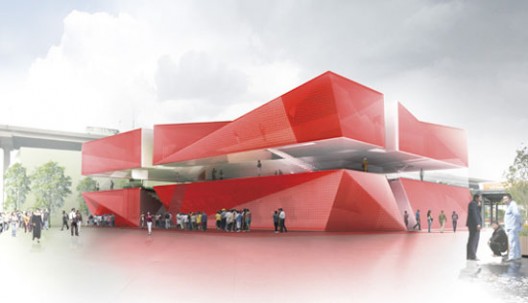
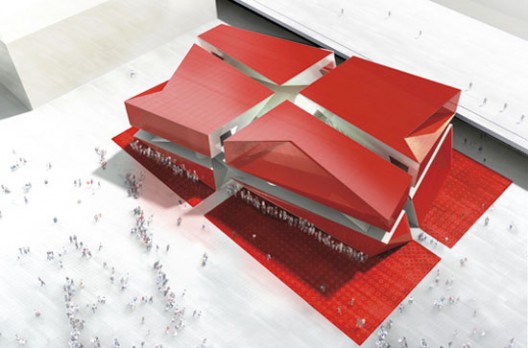
queens-museum-by-elliot-white-19_gallery2-interior.jpg

Unexpectedly the physical modeling of the cloth produced a most interesting and unintended result.  This unexpected result however, provided a fantastic jumping off point for digital exploration. By raising the program off the ground level a public space is created under the building that offers access round the clock, offering space for events even when the museum is closed.

queens-museum-by-elliot-white-11_bladder-inside-lattice.jpg

A structural lattice provides ample interior spaces while creating a process that significantly simplifies construction. A plastic ‘bladder’ is inflated inside the structural lattice, then a layer of Concrete Canvass is laid on top, sprayed with water, and sets on the outside of the lattice.

queens-museum-by-elliot-white-09_structural-lattice.jpg

As for the interior, I wanted to create a sense of corporeality.  To accomplish this I have taken the top lines of the interior of the shell and pulled them out in a manner that creates a landscape that must be negotiated in three dimensions.  The interior walls would be constructed out of stacked glass, creating translucent divisions of the rooms.

queens-museum-by-elliot-whi.jpg

queens-museum-by-elliot-white-04_cloth-test-renders.jpg

queens-museum-by-elliot-white-25_model.jpg

queens-museum-by-elliot-white-26_model.jpg

Vertical City

ساخت بلندترین برج دنیا به ارتفاع ۲۴۰۰ متر می باشد .

این برج  شهر عمودی نام گذاری شده است.

لینک دانلود

password:            www.memari.plb.ir

تحول در بحرین

تحول در بحرین

لینک دانلود

password:            wWw.Memari.PLB.ir

غرفه ی دانمارک در نمایشگاه جهانی شانگهای - ۲۰۱۰

غرفه ی دانمارک در نمایشگاه جهانی شانگهای - ۲۰۱۰

طرح توسط یکی از مشهور ترین گروه های معماری دانمارک، به نام BIG داده شده است که توسط معمار معروف دانمارکی، Bjarke Ingels  تاسیس شده، که در ارائه ی گویا و دقیق طرح هایش از بهترین ها محسوب می شود. پروژه برای نمایشگاه جهانی شامگهای که قرار است در سال ۲۰۱۰ برگزارشود داده شده است و در آن به صورتی افراطی، از تمامی المان هایی که بیانگر  دانمارکی بودن مجریان طرح باشد استفاده شده، به طوری که می توان آن را بخشی از خاک دانمارک به شمار آورد.

طرح کلی، شامل یک راهروی عظیم مارپیچ است که شرکت کنندگان و بینندگان نمایشگاه، می توانند از بین غرفه های آن حرکت کنند، و جالب اینکه این راه ها مانند راه ها و خیابان های دانمارک طراحی شده! در مرکز این راهرو های پیچ در پیچ، استخری بزرگ قرار گرفته که مانند لنگر گاه های دانمارک است و در مرکز این استخر، مجسمه ای از یک پری دریایی قرار گرفته که نمادی از دانمارک محسوب می شود و به صورت موقت و تنها برای این غرفه، از دانمارک به چین حمل خواهد شد.

ده اتفاق برتر باستان شناسی جهان در سال گذشته


ده اتفاق برتر باستان شناسی جهان در سال گذشته


 هر روزه اتفاقاتی مختلفی در حوزه باستان شناسی رخ می دهد که باعث می شود اسرار دنیای باستان هر یک پس از دیگری افشا شود.باستان شناسی قبل از این که یک علم کاملآ دانشگاهی به شمار رود یک هنر برای پیوند زدن یافته ها با شواهد تاریخی است . هنری که با پیوند زدن زنجیرهای کوچکی که در دنیای باستان شناسی وجود دارد باعث می شود تا پازل دیگری بر گمشده های دنیای باستان اضافه شود.

از دیگر سو شاید مهمترین اصل در علم باستان شناسی صبوری و مطالعات زیاد باستان شناسان باشد که باعث می شود این علم نسبت به دیگر علوم رنگ و رویی دیگر به خود بگیرد.

اصولآ در حوزه باستان شناسی یا مطالعات دامنه دار است و طولانی که بر روی یک محوطه تاریخی به طور متناوب و در طول مدت چند سال صورت می گیرد و یا آنکه بر اثر یک اتفاق یا کاووشی یکباره قطعه دیگری از این پازل برای بیان حقایق بیشتری از تاریخ رو می شود.

اما در میان اتفاقاتی که در حوزه باستان شناسی رخ می دهد برخی از این اتفاقات به خود شکل دیگری می گیرند و با توجه به نوع کشف و برد جهانی و مسایل دیگری که نشان از چگونگی زندگی انسانی در دوران باستان دارد از همه بیشتر جلوه می کند..

این اتفاقات که در دنیای باستان شناسی تنها هر از چند گاهی رخ می دهد و شاید در برخی موارد سالها صبر و حوصله رامی طلبد در سال گذشته میلادی در ده مورد باعث شد تا شگفتی باستان شناسان و علاقه مندان به علم باستان شناسی را بر انگیزد.این ده مورد اکتشاف که از ابتدای سال گذشته میلادی تا انتهای آن مورد بررسی قرار گرفت تا آنجا پیشرفت رفته است ، که در برخی از این موارد، روند مطالعاتی دانشمندان این حوزه را به سمت و سویی جدید تر رهنمون ساخت.

در این مطلب به اختصار به ده کاووش برتر باستان شناسان سراسر جهان اشاره شده است


onarchitectureline.blogfa.com


1- کشف گور دسته جمعی

یکی دیگر از کشفیات باستانی که باعث شد در سال گذشته نظر بسیاری را به خویش معطوف دارد ، کشف یک گور دستجمعی از طاعون زده هایی است در جزیره کوچک قرنطینه شدگان در نزدیکی ونیز رخ داد..این کشف که در 29 آگوست سال گذشته رخ داد باعث شد بسیاری از محققان و کاووشگران را به اینمنطقه باستانی بکشاند تا ایشان از نزدیک به باقیمانده های حادثه بزرگی که طاعون در اروپا به وجود آورد

 و به واسطه آن بسیاری از اطلاعت این بخش از تاریخ نیز دفن شد دوباره بازیابی نمایند.در این گور دستجمعی بیش از 1500 اسکلت پیدا شد که همگی متعلق به بیمارانی است که نوع خاصی از طاعون را به نام طاعون خیارکی که همگی در جزیره ای کوچک در نزدیکی ونیز دفن شده بودند .طاعون سیاه یا مرگ سیاه یک اپیدمی طاعون خیارکی است که کل اروپا را در سال ۱۳۴۷ تا ۱۳۵۰ میلادی دربرگرفت. تعداد مرگ‌و‌میر از بیماری طاعون در این دوره کاملاً مشخص نیست، اما برآورد آن حدود یک‌چهارم تا پک‌سوم جمعیت اروپا، یا ۲۵ ملیون نفر طی این سه سال است. در اواخر سال ۱۳۴۷ کشتی‌هایی که از آسیای مرکزی می‌آمدند، بیماری را در جنوا و مارسی شیوع دادند. در تابستان سال ۱۳۴۸ طاعون در ونیز نیز شایع شد و در عرض یک سال تمام سواحل مدیترانه را فراگرفت. پس از آن، طاعون به سرعت به سمت شمال اروپا حرکت کرد و جمعیت این نواحی را، که پس از قحطی‌های پی‌در‌پی، اپیدمی‌های مختلف به علت سردی هوا و جنگ‌های طولانی به شدت در برابر هر سانحه‌ای ضعیف شده‌بودند،درهم شکست. باستان شناسان معتقدند یا کشف این گور دستجمعی بسیاری از حلقه های فراموش شده این بخش از تاریخ باستان اروپا را که به واسطه شیوع این بیماری در بسیاری موارد پنهان مانده است را روشن خواهند کرد.


ادامه نوشته

ده اتفاق برتر باستان شناسی جهان در سال گذشته


2- خانه های مردمان استون هنج

از مهمترین کشفیات باستانی در سال گذشته را می توان کشف بقایای روستای 4600 ساله سازندگان استون‌هنج به نام محوطه تاریخی دورینگتن‌والز دانست که به عقیده باستان شناسان به احتمال فراوان یک روستای ابتدایی برای سکونت مردمان باستان بوده است.ساختار زیربنایی این محوطه تاریخی نشان از وجود نشانه های نخستین زندگی روستایی ی مربوط به دوران پیش از تاریخ است که در نزدیکی استون هنج پیدا شده است.کارشناسان معتقدند احتمال دارد که این محوطه تاریخی در واقع مقبره هایی باستانی باشد که در نزدیکی استونهنج برای انجام مراسم تشریفات و آیین های مذهبی از آن استفاده می شده است..در این کاووش باستانی 8 خانه دراین منطقه از زیر خاک خارج شد که پس از آن باستان شناسان احتمال دادند که 25 خانه دیگر نیز در این منطقه وجود داشته باشد.ابزار سنگی، استخوان حیوانات، پیکان و لوازم دیگر از این روستا به دست‌آمد که نشان از قدمت تاریخی این روستا دارد.

کشف بقایای خوکی که در هنگام کشته‌شدن احتمالا نه ماهه بوده است، نشان‌دهنده برگزاری جشنواره در نیمه زمستان در این منطقه است.ازنکات دیگری که در مورد این محوزه تاریخی وجود دارد و بر اهمیت آن می افزاید ، این است که استون‌هنج به جهت طلوع خورشید در اواسط تابستان و غروب خورشید در اواسط زمستان قرار گرفته است و این درحالی است که دایره چوبی سایت دورینگتن‌والز به جهت طلوع خورشید در اواسط زمستان و غروب خورشید در اواسط تابستان قرار دارد.بر اساس رای باستان شناسان دو خانه از خانه‌هایی که در این محوطه تاریخی کشف شده‌اند جدا از بقیه قرار داشته این احتمال وجود دارد که این 2 خانه سکونتگاه سران قبیله یا محل انجام مراسم مذهبی بوده است.

ادامه نوشته

معماری مقبره سازی

معماری مقبره سازی

ساختمانهای آرامگاه ها یکی از پرعظیمت ترین وشکوهمند ترین گروه های ساختمانیاست که معمولا بااستفاده از شرایط طبیعی جغرافیائی و در کنار ویاروی کوه و تعداد اندکی در دشتها احداث شده است.ترکیب بندی عمومی این مقبره ها به این قراراست قبرستان توسط دیوار احاطه گردیده و درب چهارطرف باز است و در چهار گوشه آن برج دیده بانی قراردارد و راهرویی در جلو قبرستان ایجاد شده وسراسرقبرستان زیر سایه درختان کاج و سروپربرگ وسرسبز و سربه فلک کشیده قرار داردو محیط یکپارچه سکوت و آرا مش بر آن حکمفرمااست.

 آرامگاه" چین شی خوان "

 اولین امپراتور چین آرامگاهای امپراتور "چین شی خوان "واقع در دامنه شمالی کوه "لی شان " درشهر"سی آن " استان"شن سی"مشهورترین قبرستان چینبوده و بیش از2000سال قدمت دارد. پیکره ها و مجسمه های سفالی و چوبی جنکجویان و اسبها ئیکه همراه امپراتور مرحوم "چین شی خوان" زیر خاک دفن شدهبودند ،همچون سپاه پاسداران این قبرستان بودند کهصاحب نهایت ابهت و عظمت رزمندگی بوده و اثار هنری حکاکی و تهیه شده بااستادی و مهارت عالی میباشند و هشتمین معجزه دنیا نامیده می شود که درسال1987در"فهرست اسامی میراث جهان " به ثبت رسید   کمیسیون میراث جهان این امر را این طور ارزیابی  کرد:آن پیکره های سفالی مشهور که دورادورآرامگاه امپراتور "چین شی خوان "ایستاده،با ژستهای گوناگون و متنوع و اسبها و کالسکه های جنگی و اسلحه همه آثار ظریف ومکمل رالیستی بوده و در ضمن ارزش عالی تاریخی خود را محفوظ می دارد.

در اطراف شهر "سی آن " استان "شن سی " مقبره های امپراتوران و شاهزادگان سلسله ها متمرکز است،علاوه برقبرستان یاد شده ، مقبره های 11 امپراتورحان غربی و 18 امپراتور سلسله"تان "در این محلهامحفوظ است. درمیان آرامگاههای امپراتوریسلسله"هان غربی" مقبره "لیو چیه "امپراتور "حاناو"چه از نظر مقیاس و چه ازنظر وفور گنج های محفوظه زیر زمین متمایز و برتر از دیگر مقبره هامیباشد ،قبرستان "شائو لین " که درآن "لی شی مینامپراتور "تان تای تسون "مساحت زمین بسیاروسیعیرادر اشغال داشته و در محوطه آن 17 مقبره مامورانعالی مقام ونزدیکان امپراتور نامبرده دراطرافمقبره وی دیده میشود.روی این قبرستان و زیر زمینآن سرشار ازآثارگرانقدر باستانی است. حکاکی بسیارعالی و ظریف سلسله "تان "موسوم به "6 اسب ممتاز"ازشهرت بسزائی برخورداراست

 آرامگاههای امپراتوران سلسله های "مینگ "و " چینگ

 آرامگاههای امپراتوران سلسله مین بطور عمده درشهرستان "چان پین "در حومه بیجینگ قرار دارد ومجموعه آرامگاه های 13 امپراتور سلسله مینمیباشد.این 13 امپراتور بعد از آنکه بیجینگ بعنوان پایتخت اعلام شد، بر تخت سلطنت نشستند که مساحت حدود 40کیلومتر مربع را در اشغال خود دارد.وآین قبرستان مینگ نام دارد. این آرامگاهها متمرکزترین و کاملترین مجتمع آرامگاه ها موجود در چین بحساب میاید و عظیمترین آنها مقبره "چان لین " (ازآن "جودی "امپراتور" مین چن زون ) و "دین لینمتعلق به "جو یو چینو امپراتور مین شن زونمیباشدنتیجه حفاری ها نشان میدهد که قصر هازی زیر زمینیدین لین" با سنگ مرمر بشکل گنبدی ساخته شده وتجهیزات آبکشی عالی در داخل بخوبی کار گذاشته گردیده و گنبدهای سنگی همچنان محکم مانده و نشستنکرده است که بیانگر فناوری عالی معماری پیشینیانچین در سازندگی بناهای زیر زمین است . آرامگاههایچینگ دون لین"که مساحت زمین 78کیلومتر مربعی رادر اشغال دارد، آرامگاههای خاندان سلطنتی است کهاز لحاظ مقیاس پرعظمت ترین و از لحاظ سیستم معماریکاملترین آرامگاههای موجود چین شناخته میشود. دراین آرامگاهها 5 امپراتور ،14 ملکه و بیش ازصدسوگلی امپراتور سلسله "چینگ "مدفون شده اندآرامگاههای عمده " چینگ دون لین " بطرزی بسیارظریف و دقیق وبا استادی ساحته شده است

تبيين مفاهيم معماري اطلاعات:

تبيين مفاهيم معماري اطلاعات:

اصطلاح" معماري اطلاعات" درسال هاي اخيربه عنوان واژه اي تازه درطراحي نظام هاي اطلاعاتي و طراحي وب راه يافته؛ اما هنوزهم متخصصين درارائه تعريفي واحدازآن مشكل دارند. Martin White معماري اطلاعات را همچون اطلاع رساني مجموعه اي از ابزارها و روش ها مي داند كه توسط متخصصين درمقياسي وسيع براي حل مشكلات مديريت اطلاعات استفاده مي شود. Iain Barker درتعريف معماري اطلاعات مي گويد:" معماري اطلاعات اصطلاحي است جهت توصيف ساختاريك سيستم؛ يعني شيوه اي كه درآن اطلاعات سازماندهي، كدگذاري ومنتقل مي شوند." دراين تعريف معماري اطلاعات به مثابه يك سيستم فرض شده كه داراي ورودي و خروجي هايي است، با سيستم هاي ديگردرتعامل است وهدف خاصي را دنبال مي كند. D.Grant Campell درتشريح اين اصطلاح مي گويد:" معماري اطلاعات شباهت بسياركمي با موضوعات داراي رويكرد ذهني دارد، وبيشترشبيه به رويكردهاي فلسفي مثل پديده شناسي وساختارگرايي است." قانون كلينگر- كوهن تصريح مي دارد كه معماري اطلاعات چارچوبي يكپارچه براي ارتقاء يا نگهداري فناوري موجود وكسب فناوري اطلاعاتي جديد جهت نيل به اهداف راهبردي سازمان و مديريت منابع آن فراهم مي نمايد.
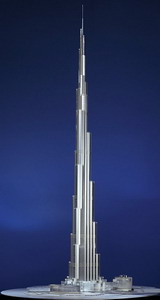
ادامه نوشته

برج دبی رکوردار بلندترین برج


کشوری که تا ۳۰سال پيش چيزی به جز شنزار نبود اينبار به گفته شيخ محمد حاکم دبی «در پی ساختن تاريخی پر افتخار برای آيندگانش است».


ادامه نوشته